

Why Power Quality Matters in Power Systems and Common Power Quality Issues
Why Power Quality Matters in Power Systems and Common Power Quality Issues https://www.theelectricalguy.in/wp-content/uploads/2026/05/maxresdefault-1-1024x576.jpg 1024 576 Gaurav Joshi https://secure.gravatar.com/avatar/f6a3006f3f7233a71d79d0e705c167ae12516870e5239627478665ae377435b3?s=96&d=mm&r=gModern industries depend heavily on stable electrical supply. Even a small disturbance can stop operations completely. That is why understanding power quality issues has become extremely important today.
Poor power quality affects industries, utilities, and even residential users. It can damage equipment, reduce efficiency, and create production losses. In some industries, restarting production after a disturbance may cost nearly $10,000.
Power quality also impacts reliability and customer satisfaction. Therefore, engineers must understand both the importance of power quality and the common issues related to it.
Table of Contents
- Why Power Quality Matters in Power Systems
- Common Effects of Power Quality Issues
- Understanding Transients in Power Quality Issues
- Long Duration Voltage Variations
- Short Duration Voltage Variations
- Voltage Imbalance in Power Quality Issues
- Waveform Distortion in Power Quality Issues
- Voltage Fluctuation and Power Frequency Variation
- Conclusion
Why Power Quality Matters in Power Systems
Modern electrical systems use advanced automation and electronic equipment. These systems improve productivity and operational efficiency. However, they are also more sensitive to voltage disturbances.
Earlier electromechanical systems were more robust. In contrast, modern electronic systems react quickly to supply fluctuations. Even a momentary voltage disturbance can stop a production line.
In some industries, restarting the complete process may take up to four hours. Semiconductor industries face even bigger risks because of voltage sags and interruptions. That is why standards like SEMI F47 were developed. These standards define voltage sag immunity for sensitive equipment.
Utilities also suffer due to poor power quality. Repeated disturbances reduce customer trust and increase complaints. Modern customers expect stable and reliable electricity at all times. Because of this, maintaining good power quality has become essential for utilities and industries alike.
Common Effects of Power Quality Issues
Poor power quality creates many technical and operational problems. Three-phase motors may overheat and fail prematurely. Equipment life also reduces because of continuous stress. Industries may face production stoppages and unexpected downtime. Poor power factor can even lead to utility penalties.
Voltage disturbances may also corrupt important data. In some cases, relays and contactors trip unnecessarily. Utilities face additional stress on generators and transformers. Harmonics may overheat transformers and reduce system efficiency.
All these issues show why engineers must understand power quality problems properly.
Understanding Transients in Power Quality Issues
Transient is one of the most common power quality issues. A transient is a momentary and undesirable event in the system. It remains only for a very short duration. A transient may appear as a voltage spike or current spike. However, it quickly dies down within microseconds.
The terms transient and surge are often used interchangeably. Lightning strikes are one major reason for transients. Switching operations in high-voltage systems also create surges.
Transients are mainly divided into two categories.
Impulsive Transients
An impulsive transient is unidirectional in nature. It appears only in one polarity direction.
These transients remain for a very short period. Lightning strokes are one of the biggest causes of impulsive transients.
Lightning impulse values are often represented as 1.2 × 50 microseconds. This means the waveform reaches its peak in 1.2 microseconds and reduces to half by 50 microseconds.
Oscillatory Transients
Oscillatory transients behave differently. They occur in both positive and negative directions.
These transients remain longer than impulsive transients. In many cases, they last for a few milliseconds.
Based on frequency, oscillatory transients have three categories:
- High frequency transients
- Medium frequency transients
- Low frequency transients
Capacitor bank switching often causes oscillatory transients. Sudden stoppage of large motors may also create these disturbances.
Long Duration Voltage Variations
Long duration voltage variations remain in the system for more than one minute. These variations affect RMS voltage values at power frequency.
This category mainly includes overvoltage, undervoltage, and sustained interruptions.
Overvoltage
Overvoltage occurs when RMS voltage exceeds 110% for more than one minute.
Load switching is one major cause of overvoltage. Incorrect transformer tap settings may also create this issue.
Undervoltage
Undervoltage occurs when RMS voltage falls below 90% for more than one minute.
Heavy loading and overloaded circuits often create undervoltage conditions. Capacitor bank switching may also contribute to voltage drops.
Sustained Interruptions
A sustained interruption occurs when supply voltage becomes zero for more than one minute.
Such conditions often require manual intervention before restoring supply.
Short Duration Voltage Variations
Short duration voltage variations remain for less than one minute. These are also very common power quality issues in modern systems.
This category mainly includes voltage sag, voltage swell, and interruptions.
Voltage Sag
Voltage sag is a temporary reduction in voltage. It usually remains between 10% and 90% of rated voltage. Load switching and motor starting are common reasons for voltage sag. Sensitive equipment may malfunction during these events.
Voltage Swell
Voltage swell is opposite to voltage sag. Here, voltage increases between 110% and 180% temporarily. Switching off large loads may create voltage swell conditions.
Interruptions
Interruptions occur when voltage falls below 10% for less than one minute. If the duration exceeds one minute, it becomes a sustained interruption.
Voltage Imbalance in Power Quality Issues
Voltage imbalance happens when phase voltages or phase angles become unequal in a multi-phase system. This issue is mostly seen in three-phase systems.
When we say a system is operating at 440V AC, that value assumes all three waveforms are equal. It also assumes the phase angle between all waveforms remains balanced.
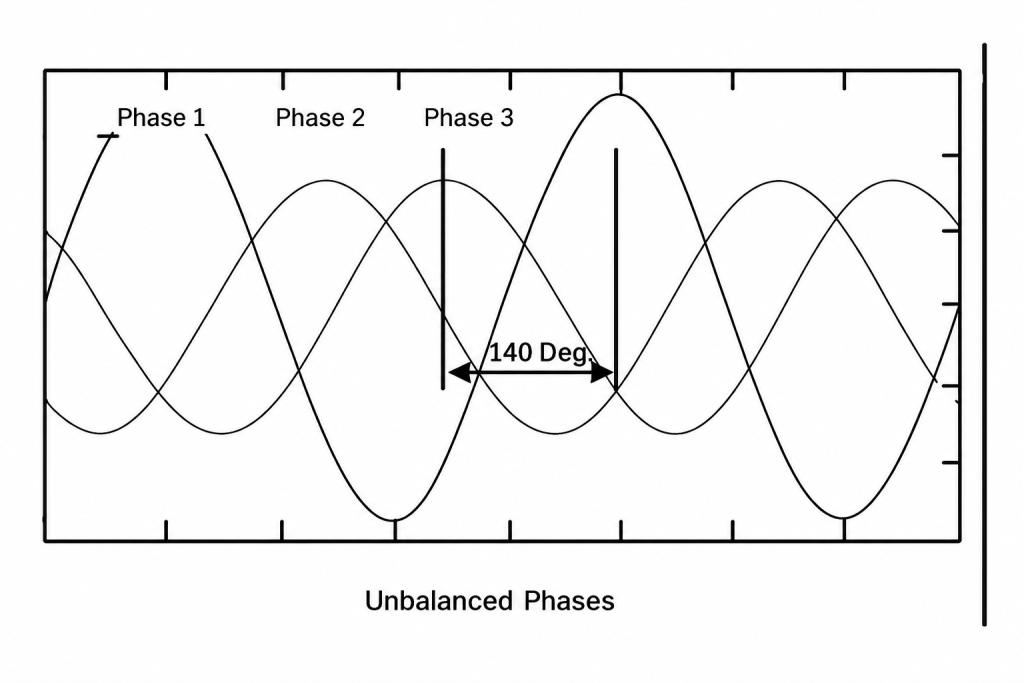
Under normal conditions, all three phases stay identical. However, if one waveform shifts or changes, the balance gets disturbed. As a result, voltage imbalance occurs.
For example, two phases may remain perfectly aligned while one phase becomes uneven. In that case, the system no longer maintains equal phase voltage and angle.
Some common causes of voltage imbalance include:
- Single-phase loads connected to three-phase systems
- Uneven load distribution
- Incorrect transformer tap settings
- Improper phase loading in distribution systems
Distribution systems commonly face this issue because most residential loads are single phase. That uneven loading creates imbalance in the three-phase network.
Waveform Distortion in Power Quality Issues
Waveform distortion is another major power quality issue. Here, the waveform loses its ideal sinusoidal shape. Instead of a clean sine wave, the waveform becomes disturbed or irregular.
Waveform distortion includes several categories:
- DC Offset:
DC offset means the presence of DC voltage in an AC system. In this condition, the waveform becomes asymmetrical. The positive and negative peaks no longer remain equal. As a result, the waveform does not cross zero properly.
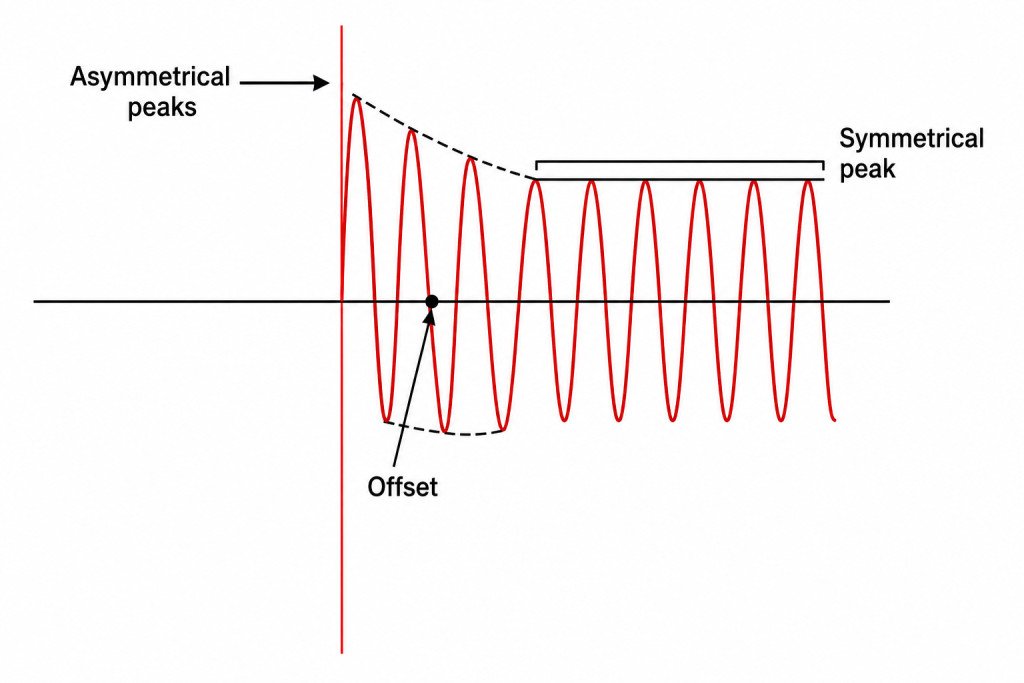
Power converters, non-linear loads, power failures, and short circuits commonly create DC offset.
- Harmonics:
Harmonics are voltage or current signals at integer multiples of the power frequency. For example, the second harmonic in a 50 Hz system becomes 100 Hz. These harmonics distort the original sine waveform and create overheating problems.
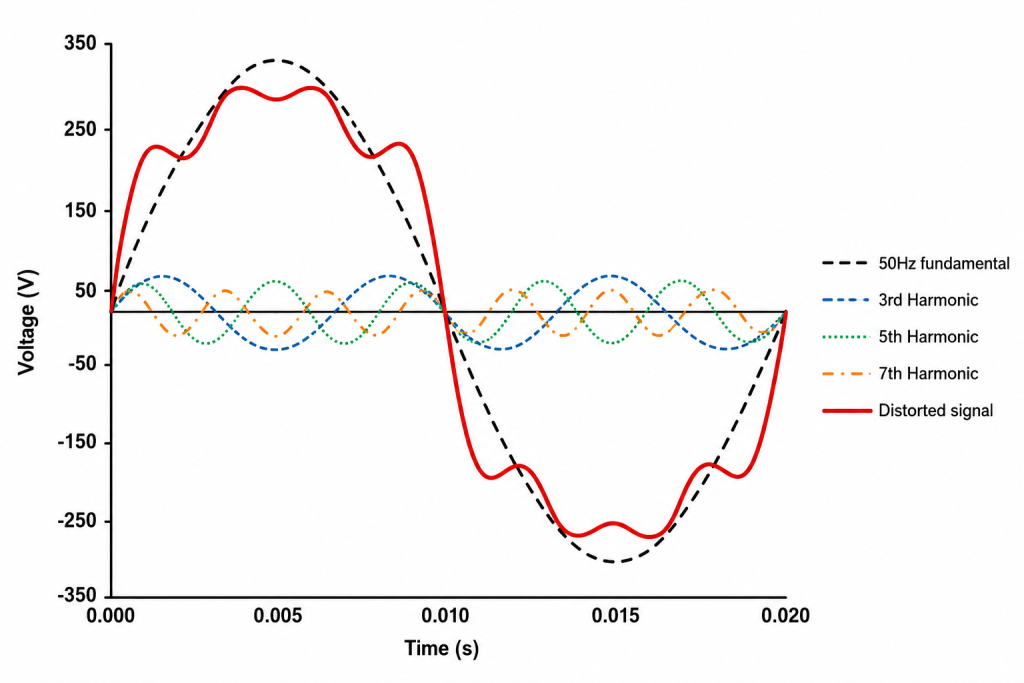
Variable frequency drives, power converters, arc furnaces, and non-linear loads are major harmonic sources.
- Interharmonics:
Interharmonics are similar to harmonics, but they are not integer multiples of the power frequency. The causes of interharmonics are mostly similar to harmonics. However, their frequencies fall between normal harmonic frequencies.
- Notching:
Notching is a periodic voltage disturbance caused by power electronic devices. It mainly appears when current shifts from one phase to another.
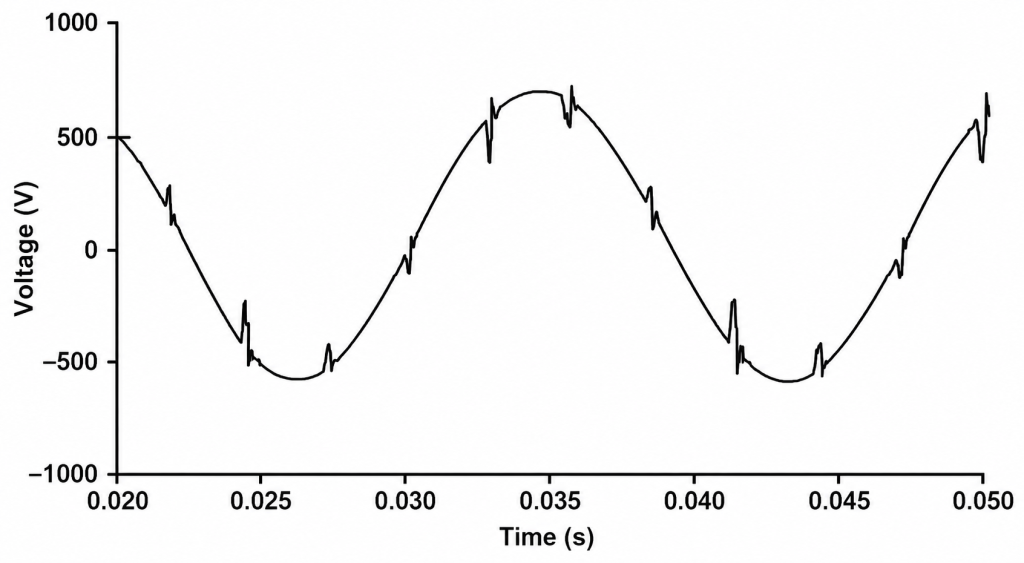
Three-phase converters and HVDC systems commonly create notching in power systems.
- Noise:
Noise occurs when random electrical signals disturb power or communication signals. It mainly affects communication systems and sensitive electronics.
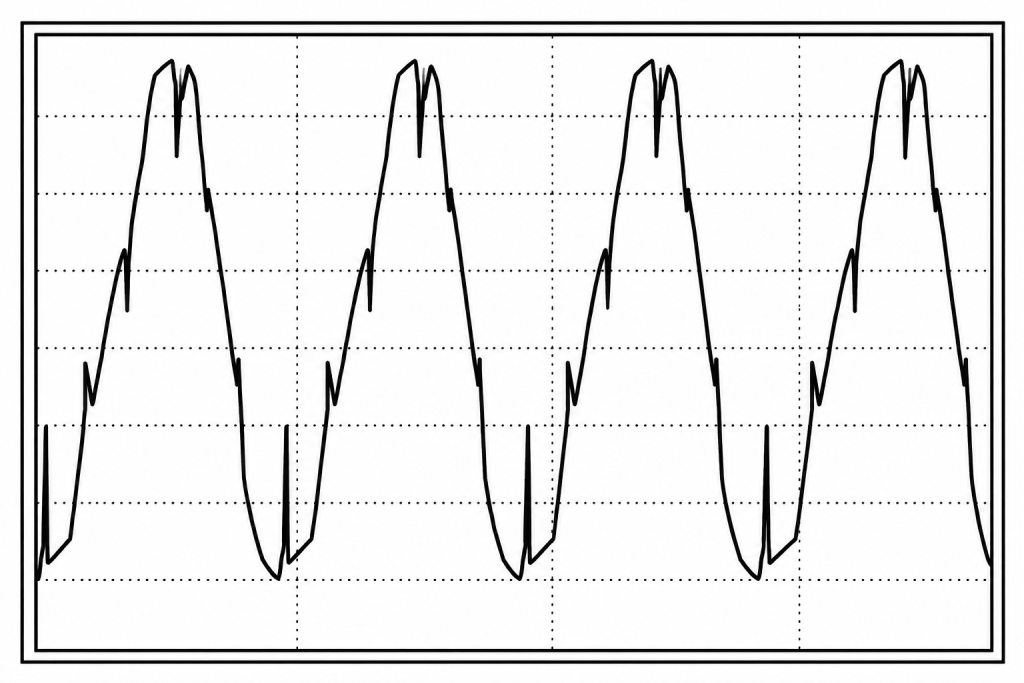
Power electronic devices, control circuits, switching power supplies, and solid-state rectifiers often create electrical noise.
Voltage Fluctuation and Power Frequency Variation
Voltage fluctuation means random voltage changes within normal operating limits.
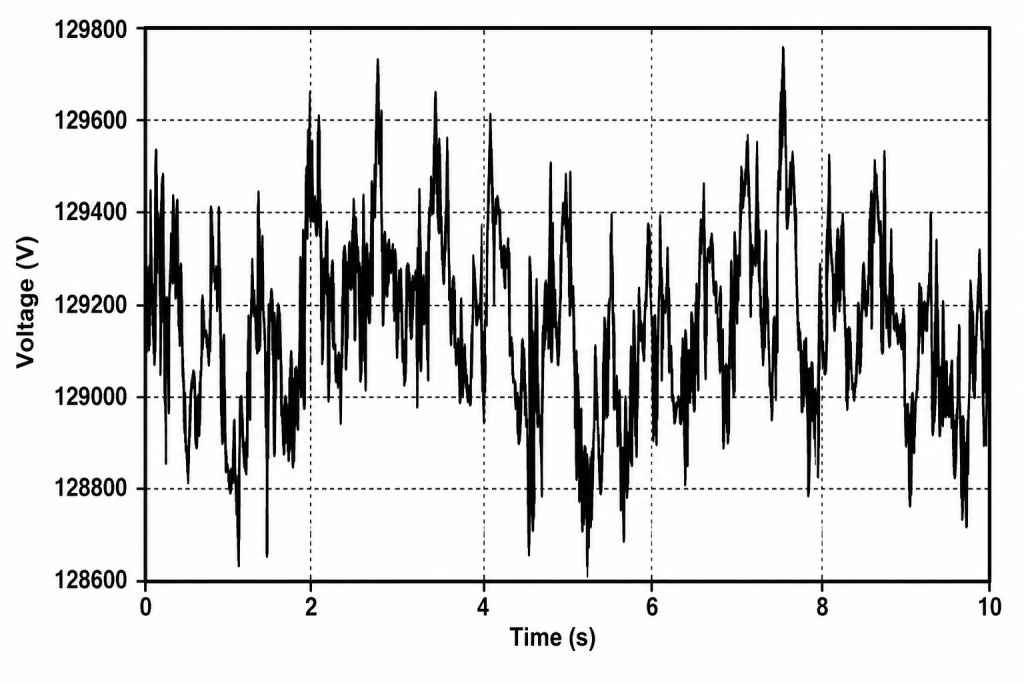
Common causes include:
- Load changes
- Generation changes
- Arc furnaces
- Resistance welders
- Rolling mills
Voltage fluctuation also causes light flickering in homes. Because of this, flickering and voltage fluctuation often mean the same thing. Power frequency variation occurs when system frequency deviates from 50 Hz or 60 Hz.
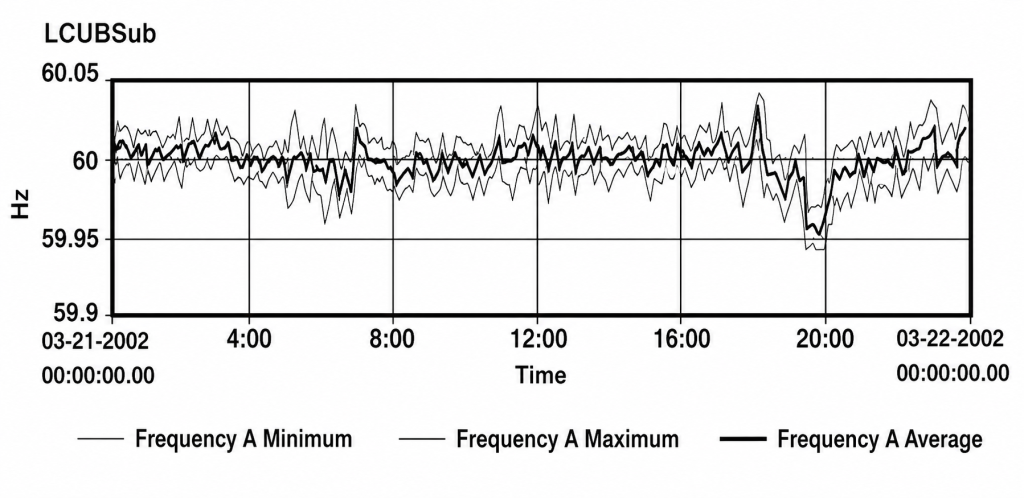
Modern systems rarely face large frequency variations. However, engineers still monitor frequency carefully because it affects grid stability.
Conclusion
Power quality directly affects reliability, efficiency, and equipment life. Even small disturbances can create serious industrial and financial losses. Modern systems have become more sensitive than before. Because of this, understanding power quality issues is now essential for every engineer.
From transients to harmonics, each issue affects the system differently. Therefore, proper monitoring and corrective measures become very important. For a clearer and more practical understanding, it is recommended to watch the full video explanation.

