

What Causes Voltage Sag and Interruption in Power Systems?
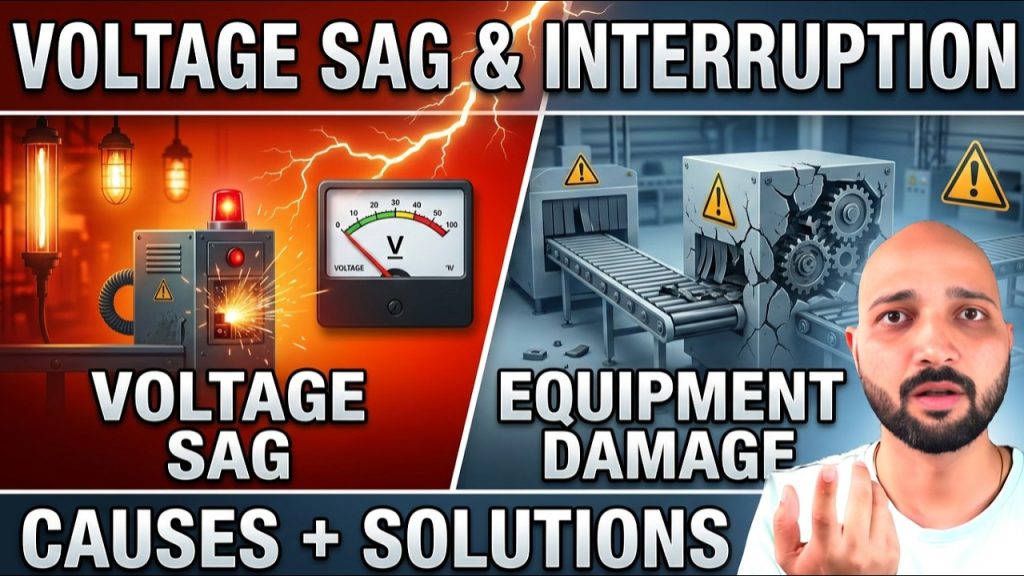
What Causes Voltage Sag and Interruption in Power Systems? https://www.theelectricalguy.in/wp-content/uploads/2026/05/maxresdefault-4-1024x576.jpg 1024 576 Gaurav Joshi https://secure.gravatar.com/avatar/f6a3006f3f7233a71d79d0e705c167ae12516870e5239627478665ae377435b3?s=96&d=mm&r=gImagine your plant running smoothly without any issue. Motors operate normally, PLC panels remain healthy, and VFDs control the process correctly. Suddenly, the lights blink for a fraction of a second. The supply does not completely fail, yet the process stops immediately.
This is where voltage sag and interruption become important. Many industries do not fail because of a complete blackout. Instead, a very short voltage dip creates major operational problems. Sensitive equipment reacts quickly to these disturbances and shuts down the process.
Understanding these disturbances helps engineers reduce downtime and improve reliability.
Table of Contents
- Understanding Voltage Sag in Power Systems
- What is Voltage Interruption?
- Causes of Voltage Sag and Interruption
- Impact of Voltage Sag and Interruption on Industries
- Magnitude and Duration in Voltage Sag Analysis
- Practical Solutions for Voltage Sag and Interruption
- Conclusion
Understanding Voltage Sag in Power Systems
A voltage sag is a short duration reduction in RMS voltage. The voltage usually falls between 10% and 90% of rated voltage. The duration normally remains between half a cycle and one minute.
In simple words, voltage sag means voltage drops temporarily but does not become zero.
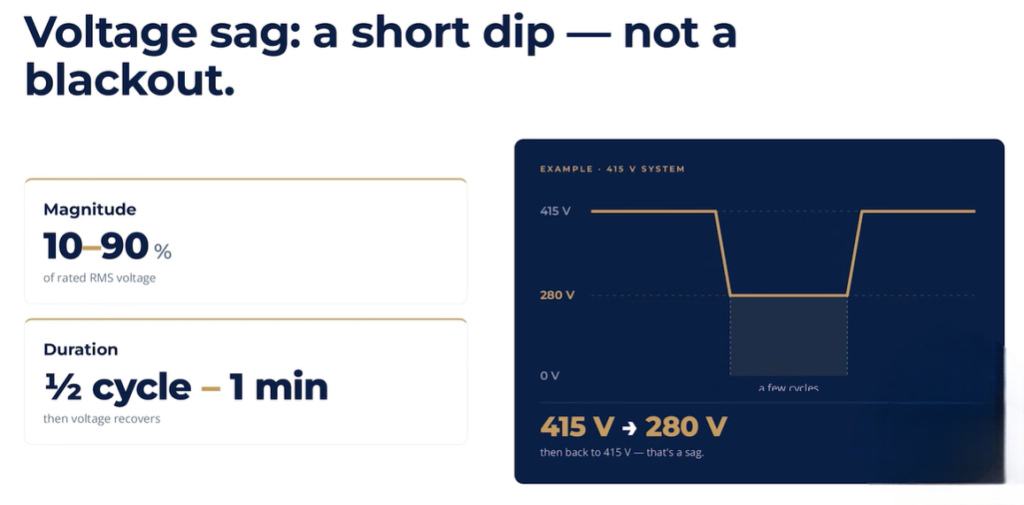
For example, suppose the system voltage is 415V. During a disturbance, voltage may suddenly fall to 280V or 250V for a few cycles. After that, it returns to normal. This condition is called voltage sag.
The most important factor here is duration. Voltage sag remains for a very short period. Sometimes it lasts for only a few cycles. In other cases, it may continue for a few seconds.
Voltage sag commonly occurs because of:
- System faults
- Large motor starting
- Transformer energization
- Sudden heavy loading
Do not confuse voltage sag with undervoltage. Undervoltage usually lasts for more than one minute. Voltage sag appears suddenly and recovers quickly.
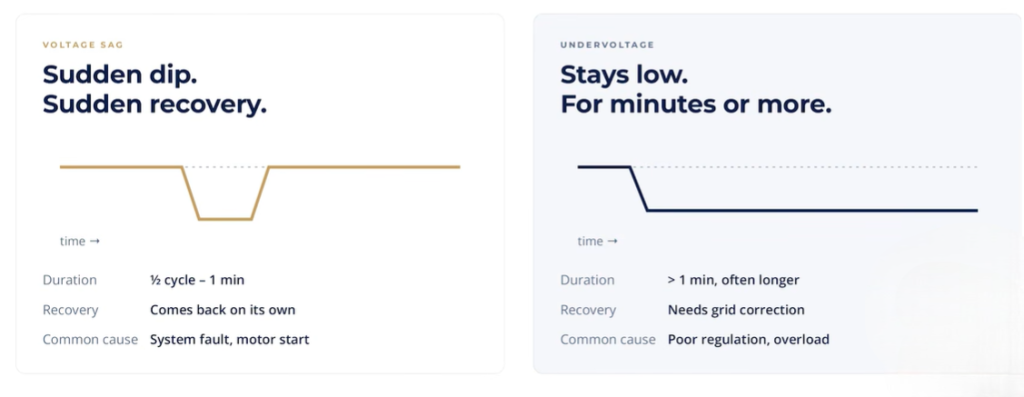
However, even that short disturbance can stop an industrial process.
What is Voltage Interruption?
Voltage interruption happens when voltage becomes zero or nearly zero for less than one minute. Unlike voltage sag, the supply almost completely disappears.
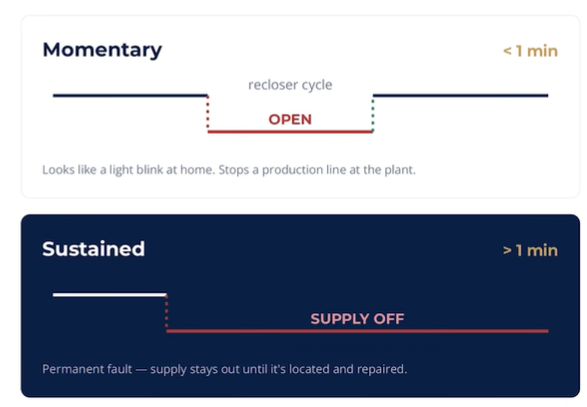
If the interruption lasts for only a few seconds, it becomes a momentary interruption. However, if it continues for more than one minute, it becomes a sustained interruption.
A common example involves utility auto-reclosing operation. Suppose a tree branch touches an overhead line. The protection system detects the fault and trips the feeder breaker. After a short delay, the breaker closes again automatically. If the fault clears, supply returns quickly.
Residential users may only notice a small light blink. However, industrial plants may experience complete production stoppage.
Causes of Voltage Sag and Interruption
Voltage sag and interruption mainly occur because of disturbances in the power system. In practical systems, some causes appear more frequently than others. Understanding these causes helps engineers diagnose problems faster and select better solutions.
1. Power System Faults
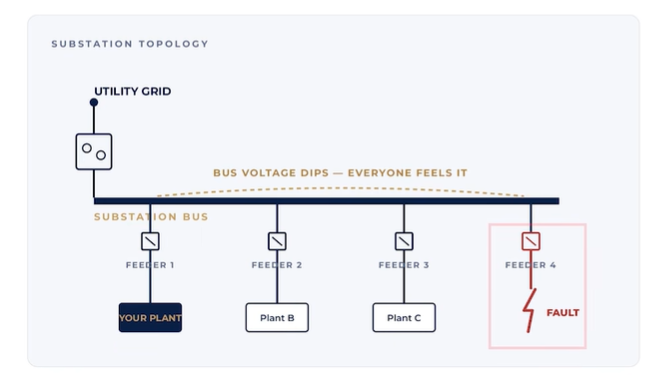
The most common reason behind voltage sag and interruption is a power system fault. A fault creates an abnormal current path in the network. During the fault, very high current flows through the system. Because of this, voltage drops across nearby sections of the network.
Common fault types include:
- Single line to ground fault
- Line to line fault
- Double line to ground fault
- Three-phase fault
Single line to ground faults occur most frequently, especially on overhead lines. During the fault period, nearby loads experience voltage sag. If the breaker trips, interruption also occurs.
Sometimes the fault may not even exist on your own feeder. Yet your plant may still experience voltage sag because the substation bus voltage dips during the disturbance.
2. Large Motor Starting
Starting large induction motors creates another major cause of voltage sag. During starting, motors draw very high inrush current. In many cases, starting current becomes five to seven times the full load current.
If the system is weak, this high current creates temporary voltage dip. Sensitive devices may then trip during motor starting conditions.
That is why proper motor starting studies become important. Engineers often use:
- Soft starters
- VFDs
- Star-delta starters
- Auto-transformer starters
These methods help reduce voltage sag during starting.
3. Transformer Energization
Transformer energization also creates temporary voltage disturbances. When a transformer energizes, it draws magnetizing inrush current. This current remains very high for a short duration.
In weak systems, this inrush current can create noticeable voltage dip. Nearby sensitive equipment may respond to this disturbance and trip unnecessarily.
4. Heavy and Fluctuating Loads
Sudden heavy loading creates additional voltage variations in the network. Some industrial loads fluctuate continuously and disturb system voltage.
Common examples include:
- Arc furnaces
- Welding loads
- Capacitor bank switching
- Sudden load switching
- Downstream short circuits
These conditions disturb voltage stability and increase the chances of voltage sag and interruption.
Impact of Voltage Sag and Interruption on Industries
Earlier industrial systems mainly used motors, lamps, and simple contactors. Those systems tolerated short disturbances relatively well.
Modern plants operate differently today. Industries now use:
- PLCs
- VFDs
- Servo drives
- SCADA systems
- Electronic relays
- Communication modules
- Sensors
These devices improve automation and efficiency. However, they also become highly sensitive to voltage disturbances.
A short voltage sag may not stop the motor directly because motors have inertia. Still, the control system may trip immediately.
For example:
- Contactor coils may drop out
- PLC power supplies may reset
- VFDs may detect undervoltage
- Relays may operate unexpectedly
Once the control system trips, the entire process stops.
Process industries face even bigger losses. Production may stop for several minutes or hours. That creates:
- Production downtime
- Material wastage
- Quality rejection
- Manpower loss
- Delivery delays
- Equipment damage
Therefore, power quality is not only an electrical topic. It also affects business continuity directly.
Magnitude and Duration in Voltage Sag Analysis
Two factors become very important while studying voltage sag:
- Magnitude
- Duration
Magnitude means how deep the voltage dip becomes. Duration means how long the dip remains.
For example, a sag to 80% voltage for five cycles may not affect certain equipment. However, a sag to 40% for the same duration may trip many devices.
Similarly, one device may tolerate short voltage dips while another device trips immediately.
Engineers therefore use voltage ride-through curves for analysis. These curves show how much voltage drop equipment can tolerate and for how long.
Some devices mainly react to voltage magnitude. Others react to both duration and magnitude.
That is why engineers must study:
- Minimum voltage level
- Duration of sag
- Affected phases
- Tripped equipment
- Ride-through capability
Without proper analysis, finding the real problem becomes difficult.
Practical Solutions for Voltage Sag and Interruption
There is no single solution for every industrial plant. The correct solution depends on equipment sensitivity, process requirements, utility conditions, and budget. However, engineers should first identify the weakest point in the system.
Protecting a small control circuit is usually cheaper than protecting the entire plant.
1. Better Equipment Specification
The first solution is selecting equipment with proper voltage ride-through capability. Engineers should always check how much voltage dip the equipment can tolerate and for how long.
Critical equipment should handle common voltage disturbances without tripping. Solving the issue during the specification stage becomes the cheapest approach.
2. Control Power Protection
Many shutdowns happen because control power becomes unstable. In many cases, the main motor remains healthy while the control circuit trips.
Small backup systems can prevent this issue, such as:
- Small UPS systems
- DC backup supplies
- Capacitor-based ride-through modules
- Control transformer support
For small control loads, this becomes one of the most practical solutions.
3. Voltage Compensators and Dynamic Voltage Restorers
Voltage compensators detect voltage sag and inject the missing voltage immediately. These systems help maintain acceptable voltage at the load side.
For example, if supply voltage drops to 40%, the compensator restores the required voltage level. Some devices react within a fraction of a cycle.
Industries with high downtime cost commonly use these systems.
4. UPS Systems
UPS systems provide strong protection against voltage sag and interruption. Online UPS systems continuously feed the load through inverter operation.
Standby UPS systems operate differently. They transfer supply during disturbances. However, transfer time becomes important for sensitive loads.
Hybrid UPS systems combine features of both approaches.
UPS systems are commonly used for:
- IT loads
- PLC systems
- Instrumentation
- Critical machines
5. Motor Generator and Flywheel Systems
Motor generator systems use mechanical inertia for ride-through support. When input supply fails briefly, rotating inertia continues supplying power.
Flywheel systems work similarly using high-speed rotating systems and power electronics. These systems become useful where frequent short disturbances occur.
6. Static Transfer Switch and Utility Improvements
Facilities with two independent power sources may use static transfer switches. These switches transfer supply very quickly during disturbances.
Static transfer switches use power electronics for faster operation. However, both sources must remain truly independent.
If both supplies come from the same substation bus, transfer switching may not solve the issue properly.
Utilities can also reduce disturbance frequency by improving:
- Protection coordination
- Fast fault clearing
- Tree trimming
- Overhead line maintenance
- Underground cabling
- Feeder automation
- System design
Industries usually combine utility improvements with internal plant protection for critical loads.
Conclusion
Voltage sag and interruption are major power quality problems in modern industries. Even a disturbance lasting only a few cycles can stop critical processes.
Most problems occur because modern control systems are highly sensitive. Therefore, understanding the real cause becomes very important.
Instead of protecting the entire plant, engineers should identify the most sensitive section first. That approach provides the best technical and economical solution.
For a clearer and more practical understanding, it is recommended to watch the full video explanation.

