


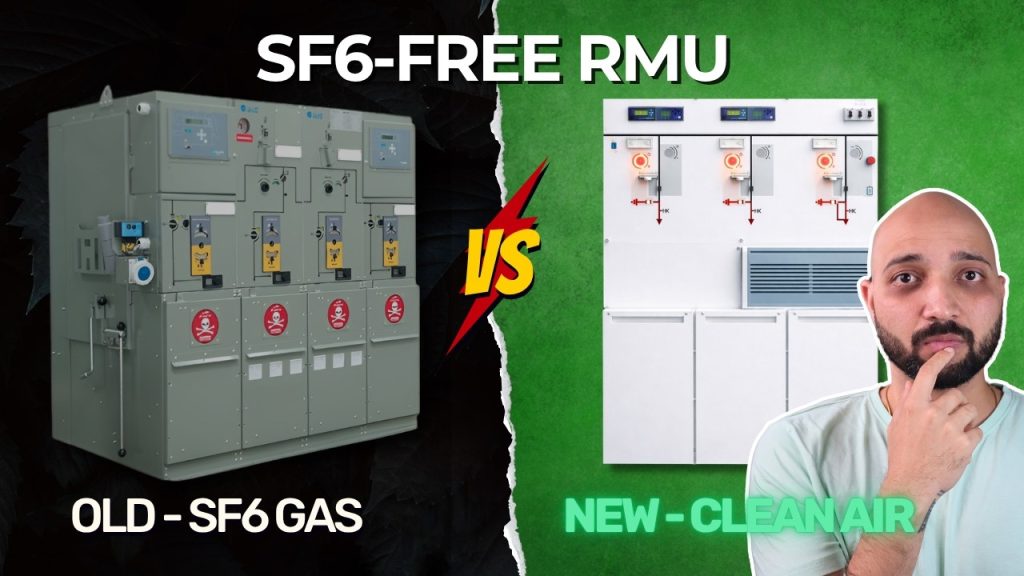
What is an SF6-Free RMU? Future of 24kV Gas Insulated Switchgear
What is an SF6-Free RMU? Future of 24kV Gas Insulated Switchgear https://www.theelectricalguy.in/wp-content/uploads/2026/04/maxresdefault-3-1024x576.jpg 1024 576 Gaurav Joshi https://secure.gravatar.com/avatar/f6a3006f3f7233a71d79d0e705c167ae12516870e5239627478665ae377435b3?s=96&d=mm&r=gIn recent years, engineers have started asking one key question. Can switchgear work without SF6 gas? This is where the concept of SF6-free switchgear becomes important. In this article, we will understand how an SF6-Free Ring Main Unit works and why it is becoming the future of 24kV systems.
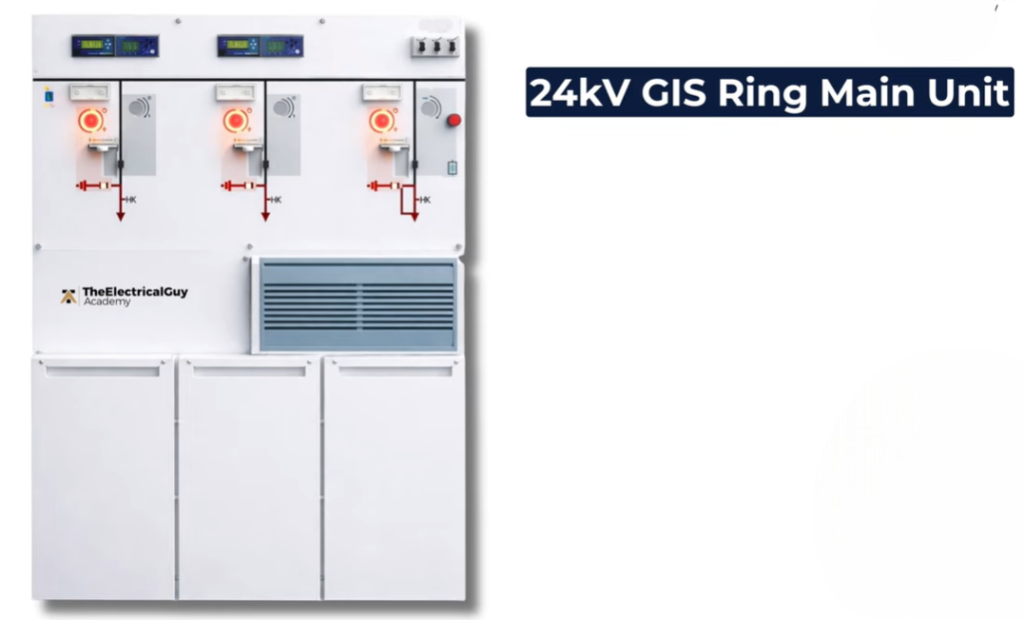
At first glance, a modern 24kV RMU looks familiar. However, one major change exists. It does not use SF6 gas anymore. This small change raises big engineering questions.
Table of Contents
- Why SF6 Was Used in Switchgear
- Why SF6-Free Ring Main Unit Is Becoming Necessary
- SF6-Free Ring Main Unit Explained: How It Works
- Components of SF6-Free Ring Main Unit
- How SF6-Free RMU Handles Dielectric Strength and Fault Currents
- Trade-offs in SF6-Free Ring Main Unit
- Is SF6-Free Switchgear Still Gas Insulated?
- Future of SF6-Free Ring Main Unit
- Conclusion
Why SF6 Was Used in Switchgear
To understand the shift, we must first know why SF6 became popular. For decades, SF6 gas supported the entire switchgear industry. It solved three major engineering challenges effectively.
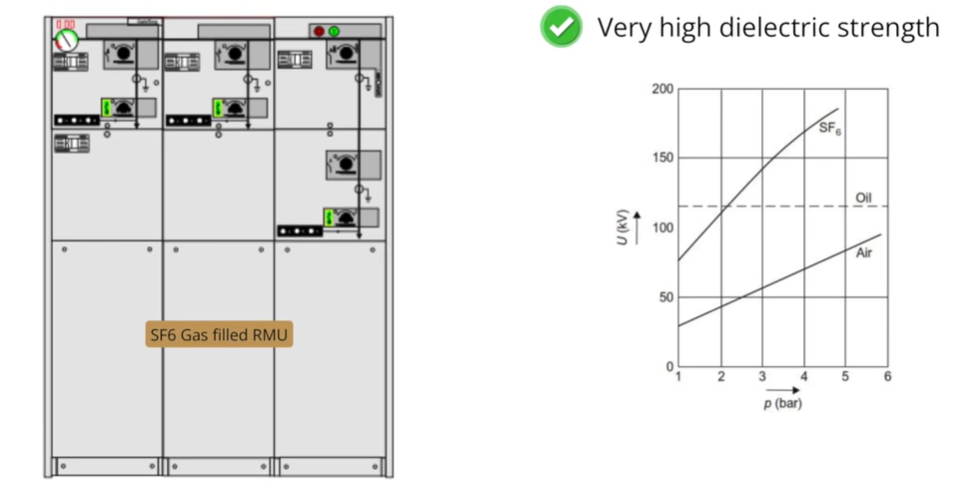
First, SF6 offers very high dielectric strength. It performs much better than air. This allows compact designs even at higher voltages.
Second, it has strong arc quenching capability. Being an electronegative gas, it absorbs free electrons. This makes it ideal for interrupting current safely.
Third, it enables compact switchgear design. Because insulation is strong, spacing can be reduced. This makes it useful in urban and space-limited installations.
Because of these advantages, SF6 replaced older technologies. Oil and air blast systems became outdated. It truly transformed the industry.
Why SF6-Free Ring Main Unit Is Becoming Necessary
Although SF6 works well, a major issue exists. The problem is environmental impact. SF6 is one of the most potent greenhouse gases.
Its global warming potential is extremely high. In fact, it is around 23,500 times higher than CO2. Once released, it remains in the atmosphere for thousands of years.
Because of this, regulations are now changing. Many regions have started banning SF6-based switchgear. For example, new rules restrict its use up to 24kV.
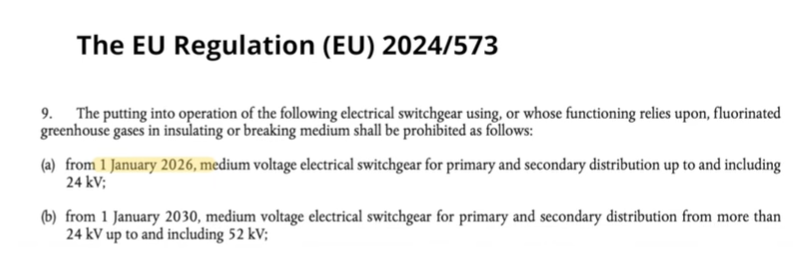
As a result, utilities and manufacturers must adapt. This shift is not optional anymore. It is becoming the new standard across the industry.
SF6-Free Ring Main Unit Explained: How It Works
Now, the main question arises. If we remove SF6, what replaces it? Engineers explored several options. Today, two practical alternatives exist.
One option is fluoronitrile gas mixtures. These have very low environmental impact. Another option is synthetic air.
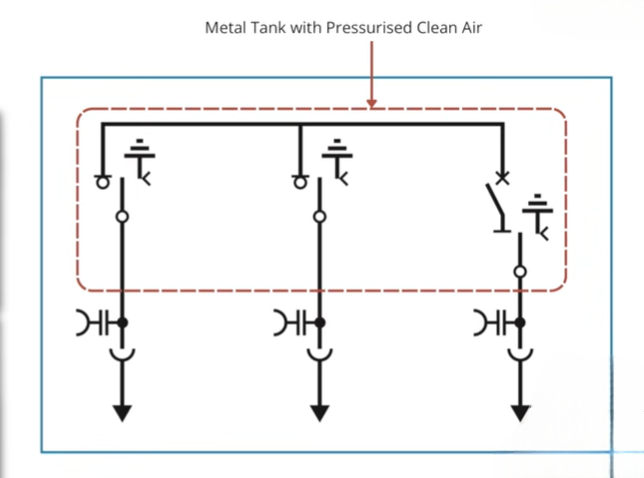
Synthetic air is a controlled mix of oxygen and nitrogen. It is not normal atmospheric air. Instead, it is a pressurized gas mixture designed for insulation.
These alternatives provide good dielectric strength. They are not equal to SF6. However, they are close enough for practical use.
Because of this, the switchgear can still remain compact. This is important for real-world installations.
Components of SF6-Free Ring Main Unit
At the component level, many engineers expect major changes. However, that is not the case. The basic structure remains almost the same.
A typical Ring Main Unit has multiple functions. It includes feeder connections and transformer connections. It also has switching devices and busbars.
Inside the metal tank, all these components are placed together. The key difference lies in the insulation medium. Instead of SF6, we now use pressurized synthetic air.
The switching function also remains unchanged. For fault interruption, vacuum circuit breakers are used.
So, the working principle stays the same. Only the insulation medium changes. This is a critical point to remember.
How SF6-Free RMU Handles Dielectric Strength and Fault Currents
Removing SF6 creates two main concerns. First, how do we maintain dielectric strength? Second, how do we interrupt high fault currents safely?
For insulation, pressurized gas plays a key role. The dielectric strength increases with pressure. So, higher pressure improves performance.
At the same time, spacing between components can be adjusted. Slightly larger gaps help maintain insulation strength.
For fault current interruption, vacuum technology is used. Vacuum circuit breakers handle high current safely.
So, insulation and switching are handled separately. This ensures reliable operation even without SF6.
Trade-offs in SF6-Free Ring Main Unit
Although the technology works, some trade-offs exist. These differences are important for engineers to understand.
The dielectric strength of alternatives is slightly lower. Because of this, small design changes are needed.
This leads to two main adjustments:
- Slight increase in internal spacing
- Higher operating gas pressure
As a result, dimensions may increase slightly. However, the increase is very small. Often, it is just a few millimeters.
Another noticeable factor is pressure. SF6 systems operate at lower pressure. In contrast, SF6-free systems use higher pressure levels.
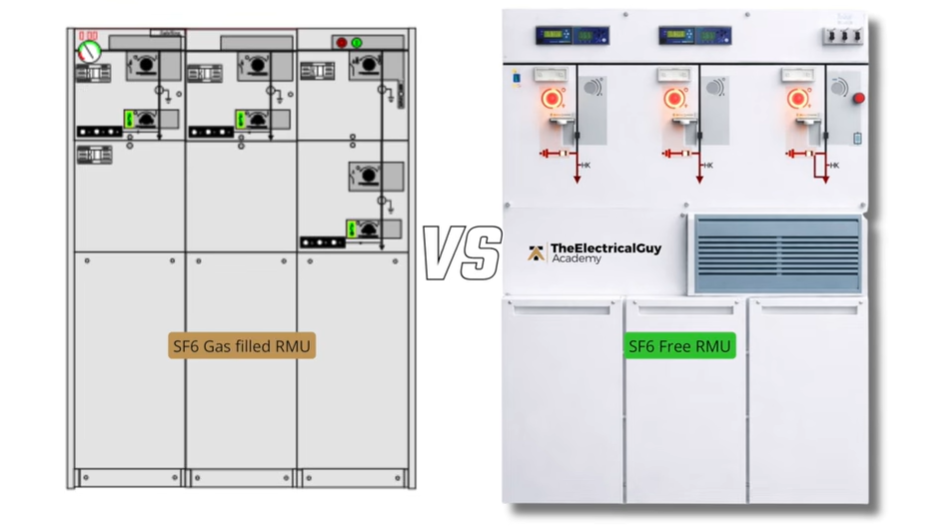
Cost is also a consideration. At present, SF6-free systems are more expensive. This is due to design and material requirements.
Despite these trade-offs, performance remains reliable. The differences are manageable in most applications.
Is SF6-Free Switchgear Still Gas Insulated?
A common doubt arises here. If we remove SF6, is it still GIS?
The answer is yes. The system still uses gas insulation. Synthetic air is also a gas. It is just a different composition.
| OEM | 24kV SF6 | 24kV SF6 Free |
| ABB | 1.4 bar | 2.5 bar |
| Siemens | 1.4 bar | 1.9 bar |
| Schneider Electric | 1.4 bar | 2.5 bar |
Therefore, it still qualifies as gas insulated switchgear. It is not the same as air insulated switchgear.
This distinction is important for understanding the technology.
Future of SF6-Free Ring Main Unit
Looking ahead, the direction is clear. SF6-free systems are not experimental anymore. They are already in use across industries.
Utilities have started adopting these systems. Manufacturers are improving designs continuously. Regulations are also pushing this transition faster.
Over time, costs will reduce. Technology will improve further. Eventually, SF6-free switchgear will become the standard choice.
This shift is driven by sustainability goals. At the same time, it maintains system reliability.
Conclusion
The move toward SF6-free RMU is not about performance issues. SF6 works well, but environmental concerns demand change. Modern alternatives like synthetic air provide a practical solution. They maintain insulation, support compact design, and ensure safe operation.
Even though some trade-offs exist, they are manageable. The core functionality of switchgear remains unchanged. In simple terms, the industry is evolving, not reinventing.
For a clearer and more practical understanding, it is recommended to watch the full video explanation.
