


What Is the Difference Between 0.2 and 0.2S Accuracy Class in CT
What Is the Difference Between 0.2 and 0.2S Accuracy Class in CT https://www.theelectricalguy.in/wp-content/uploads/2026/02/maxresdefault-1-2-1024x576.jpg 1024 576 Gaurav Joshi https://secure.gravatar.com/avatar/f6a3006f3f7233a71d79d0e705c167ae12516870e5239627478665ae377435b3?s=96&d=mm&r=gThe debate around 0.2 vs 0.2S accuracy class is one of the most confusing topics in current transformers. Many engineers assume both are identical. Others believe the difference appears at full load. However, IEC standards clearly define where the variation actually lies. Once you understand the test conditions, the confusion disappears.
Current transformers are critical in revenue metering. Even small ratio errors can affect billing accuracy. Therefore, selecting the right accuracy class is not just a technical choice. It is a financial decision. In this article, we will clearly explain the difference between 0.2 and 0.2S class based strictly on IEC 61869-2, while keeping the explanation simple and practical.
Table of Contents
- Purpose of Current Transformers and Metering Accuracy
- Testing Conditions Defined by IEC for 0.2 vs 0.2S
- Why 0.2S Has Stricter Requirements at Low Current
- Why Low-Current Accuracy Matters in Revenue Metering
- Practical Example to Compare 0.2 vs 0.2S
- Which CT Is Better for Revenue Metering?
- Conclusion
Purpose of Current Transformers and Metering Accuracy
A current transformer converts high primary current into a lower secondary current. This secondary current is usually 1 ampere or 5 ampere. It is safe and easy to measure. The output can serve two purposes. It may go to a meter for measurement. It may also go to a relay for protection.
Because these two purposes are different, CTs have separate cores. One core handles metering. Another core handles protection. The discussion of 0.2 vs 0.2S applies only to the metering core. It does not apply to protection classes like 5P or 10P.
According to IEC 61869-2, metering accuracy classes include 0.1, 0.2, 0.2S, 0.5, 0.5S, and 1. These numbers define the maximum ratio error allowed at 100% rated primary current. Ratio error can be positive or negative. Therefore, it is expressed as plus or minus percentage.
For example, if a CT is class 0.2, it allows ±0.2% ratio error at rated current. If the rated primary current is 1000 A, the ratio error must stay within ±0.2% when 1000 A flows. The same logic applies to 0.2S at 100% current.
At this stage, both classes look identical. However, the difference appears when current decreases.
Testing Conditions Defined by IEC for 0.2 vs 0.2S
IEC does not test CT accuracy only at rated current. Instead, it requires testing at multiple current levels. These levels include 120%, 100%, 20%, and 5% of rated primary current. For S classes, an additional 1% test point is required.
Consider a CT rated at 1000 A. Testing will occur at 1200 A, 1000 A, 200 A, and 50 A. For 0.2 class, IEC defines the following ratio error limits.
120% rated current, the error must remain within ±0.2%.
100%, it must remain within ±0.2%.
20%, the allowed error increases to ±0.35%.
5%, the allowed error increases further to ±0.75%.
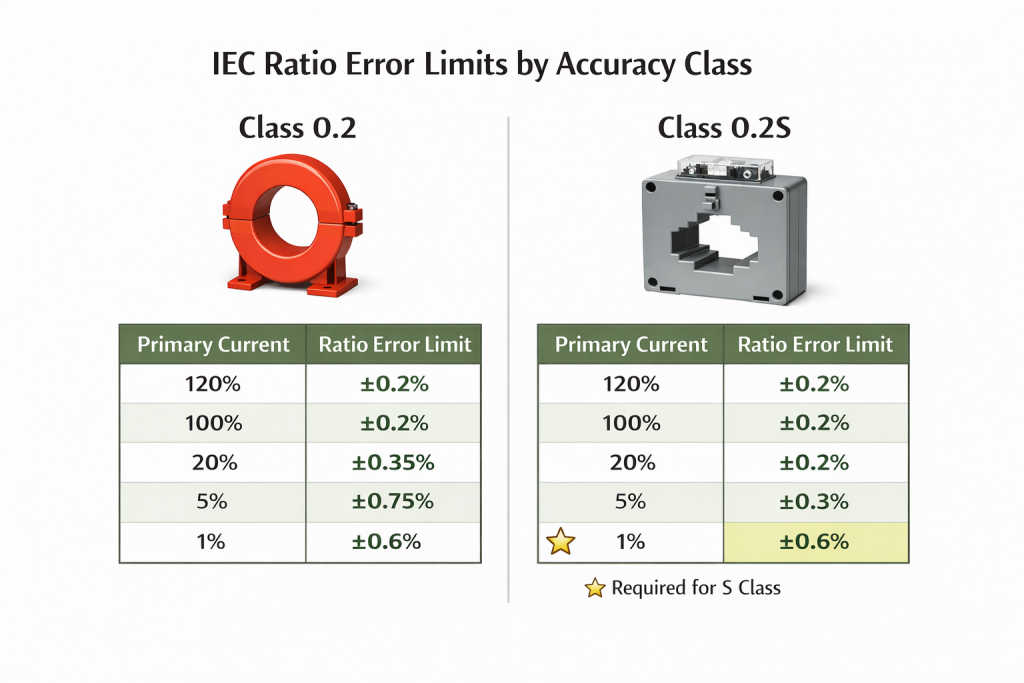
You can see a clear pattern. As the primary current reduces, the permissible ratio error increases. This happens because CT performance becomes more challenging at lower currents.
Now let us examine the same levels for 0.2S class.
Why 0.2S Has Stricter Requirements at Low Current
When we analyze 0.2 vs 0.2S, the difference becomes clear at reduced currents.
For 0.2S class, IEC defines these limits.
At 120% rated current, ratio error must remain within ±0.2%.
At 100%, it must remain within ±0.2%.
Up to this point, there is no difference between the two classes. However, changes begin at lower current levels.
20% rated current, 0.2S must remain within ±0.2%.
5%, it must remain within ±0.35%.
1% rated current, the ratio error must stay within ±0.75%.
Compare this carefully. For class 0.2, the limit at 20% was ±0.35%. For 0.2S, it is tighter at ±0.2%. At 5%, class 0.2 allowed ±0.75%. Meanwhile, 0.2S restricts it to ±0.35%.
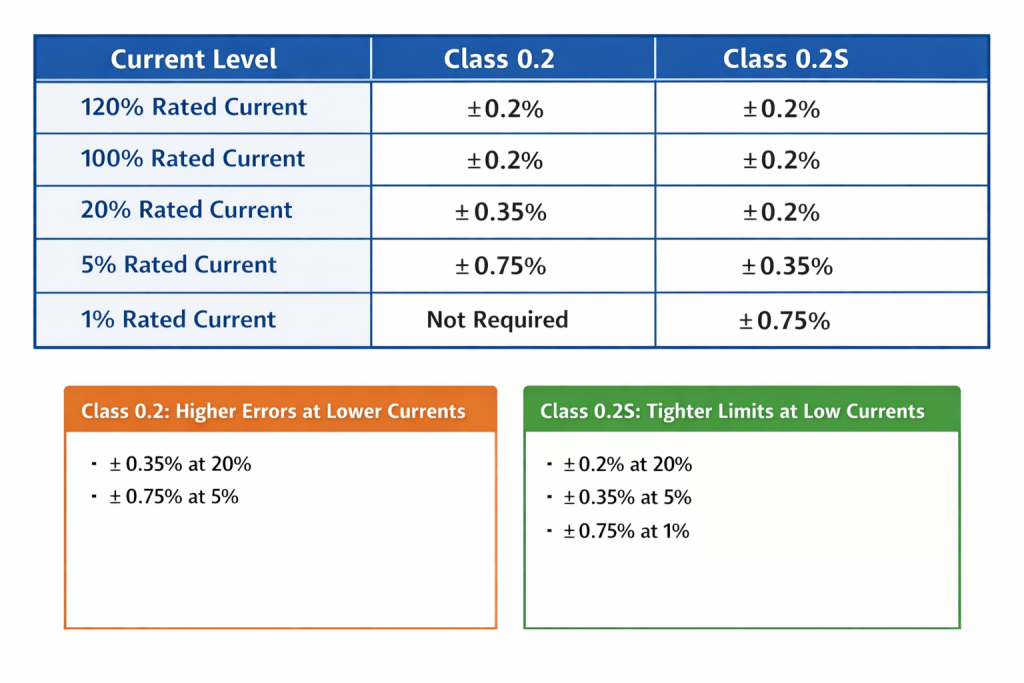
Additionally, class 0.2 does not require testing at 1% rated current. In contrast, 0.2S must pass this extra test. That makes the S class more stringent.
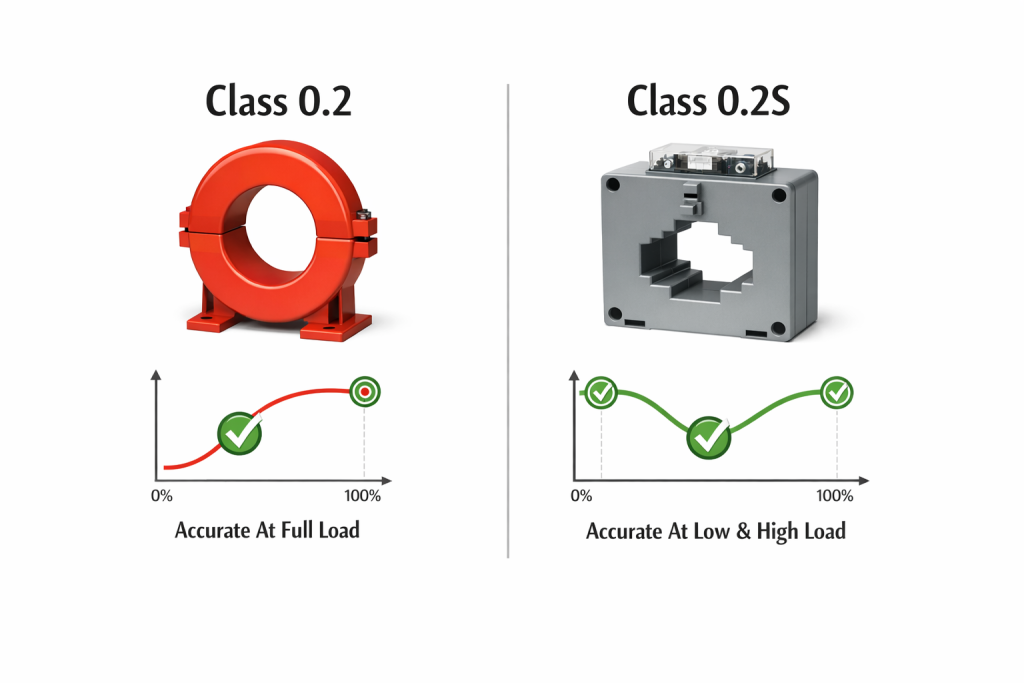
Therefore, the true difference in 0.2 vs 0.2S lies in low-current performance, not at full load.
Why Low-Current Accuracy Matters in Revenue Metering
Revenue metering does not always operate at full load. Many systems experience partial loading. Industrial plants may run lightly during night hours. Commercial facilities often show fluctuating demand.
When current levels drop, metering accuracy must still remain high. Even small ratio errors at low currents can accumulate over time. This affects billing fairness and revenue integrity.
Because 0.2S maintains tighter limits at 20%, 5%, and 1% rated current, it performs better under light-load conditions. That is why utilities often prefer it for billing applications.
In simple words, 0.2S provides better confidence when loads are low.
Practical Example to Compare 0.2 vs 0.2S
Let us take a simple example. Suppose a CT is rated at 1000 A.
At 200 A, which is 20% load, class 0.2 allows ±0.35% error. Meanwhile, 0.2S allows only ±0.2%. That is a significant improvement.
At 50 A, which is 5% load, class 0.2 allows ±0.75%. However, 0.2S restricts it to ±0.35%. Again, the S class is stricter.
At 10 A, which is 1% load, 0.2 class has no requirement. In contrast, 0.2S must maintain ±0.75% error.
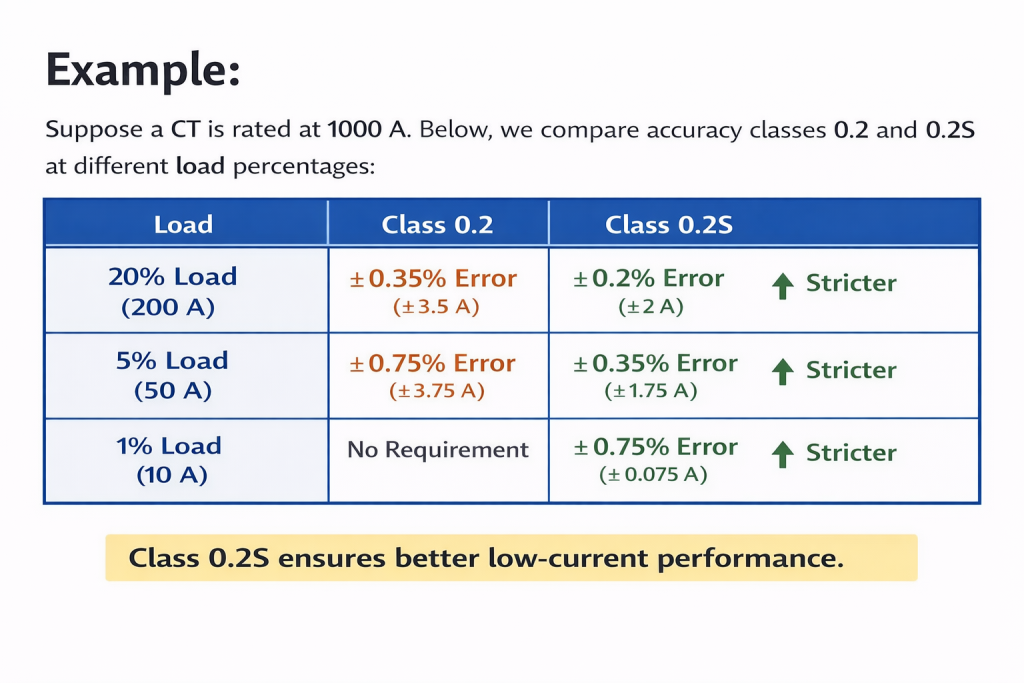
This example clearly demonstrates that 0.2S ensures better low-current performance.
Which CT Is Better for Revenue Metering?
Now the key question arises. Which class should be chosen?
If the system operates near full load most of the time, class 0.2 may be sufficient. However, if the system experiences frequent low-load conditions, 0.2S is a better option.
Revenue metering demands high confidence at all operating levels. Since 0.2S performs better at reduced current, it is generally preferred in billing applications.
Many utilities specify 0.2S for energy accounting and revenue measurement. It reduces the risk of under-registration at light loads.
Conclusion
The confusion around 0.2 vs 0.2S usually comes from focusing only on rated current. At 100% rated primary current, both classes allow ±0.2% ratio error. The real difference begins at lower current levels.
Class 0.2S has stricter limits at 20% and 5% rated current. It also requires additional testing at 1% rated current. These tighter requirements make it more suitable for revenue metering.
If accurate billing under varying load conditions is important, 0.2S offers better performance. However, final selection should always match system requirements and IEC guidelines.
For better clarity with visual explanation, it is recommended to watch the referenced video. It explains the difference step by step in a simple and practical way.

