



Advantages of Gas Insulated Switchgear (GIS)
Advantages of Gas Insulated Switchgear (GIS) https://www.theelectricalguy.in/wp-content/uploads/2025/12/maxresdefault-4-1024x576.jpg 1024 576 Gaurav Joshi https://secure.gravatar.com/avatar/f6a3006f3f7233a71d79d0e705c167ae12516870e5239627478665ae377435b3?s=96&d=mm&r=gGas Insulated Switchgear, also called GIS, is an advanced switchgear technology. It has been in the market for more than 50 years. Even though people call it modern, it is not new. It has seen many upgrades and improvements over time.
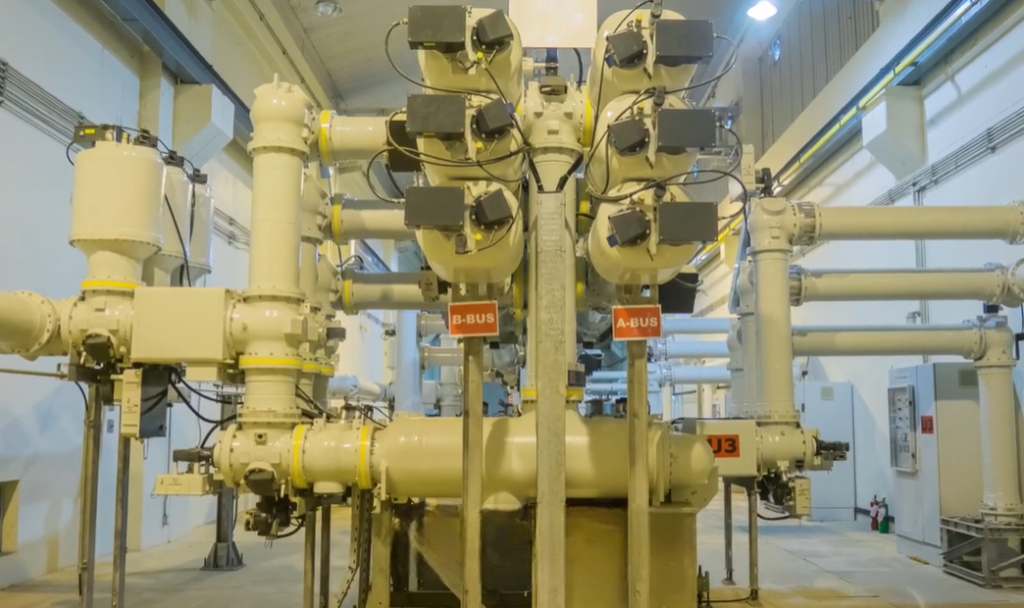
These upgrades made it more reliable. Today, it has gained huge momentum because it offers many benefits. This article explains all major advantages of Gas Insulated Switchgear (GIS). The flow follows the same points shared in the original video.
Table of Contents
- The Long Presence of Gas Insulated Switchgear (GIS)
- Super Compact Design: The Biggest Advantage of Gas Insulated Switchgear (GIS)
- Why Compactness Matters in Cities
- Gas Insulated Switchgear (GIS) Performs Well in Harsh Environments
- Gas Insulated Switchgear (GIS) Has No Altitude Impact
- Advantages of Gas Insulated Switchgear (GIS) in Reliability and Maintenance
- Reduced Environmental Impact Through Low Land Use
- Gas Insulated Switchgear (GIS) Is Much Safer
- Why These Advantages Make GIS a Popular Choice
- Summary of Key Advantages of Gas Insulated Switchgear (GIS)
- Conclusion
The Long Presence of Gas Insulated Switchgear (GIS)
GIS is not a recent innovation. It has been available for more than five decades. Many people feel it is new because it is now growing fast. Yet, power systems have used it for years. Engineers trust it because it has improved at every stage. These improvements made it stable, strong, and dependable. Due to its long presence, the performance of GIS is well-tested. This track record gives many users confidence in the technology.
Super Compact Design: The Biggest Advantage of Gas Insulated Switchgear (GIS)
The most important advantage of Gas Insulated Switchgear (GIS) is its compact design. It is often called super compact because it saves a large amount of space. Air Insulated Switchgear, or AIS, needs air as the insulation medium. Air has a low dielectric strength. So, AIS requires more distance between phases. This increases the size of the switchyard.
GIS solves this problem. It uses gases with much higher dielectric strength. A common example is SF6 gas. This gas can hold more voltage in a smaller space. So, engineers can place components close to each other. As a result, the whole system becomes compact.
A simple example shows this difference. A 145 kV GIS bay can fit inside a 10 ft by 10 ft room.
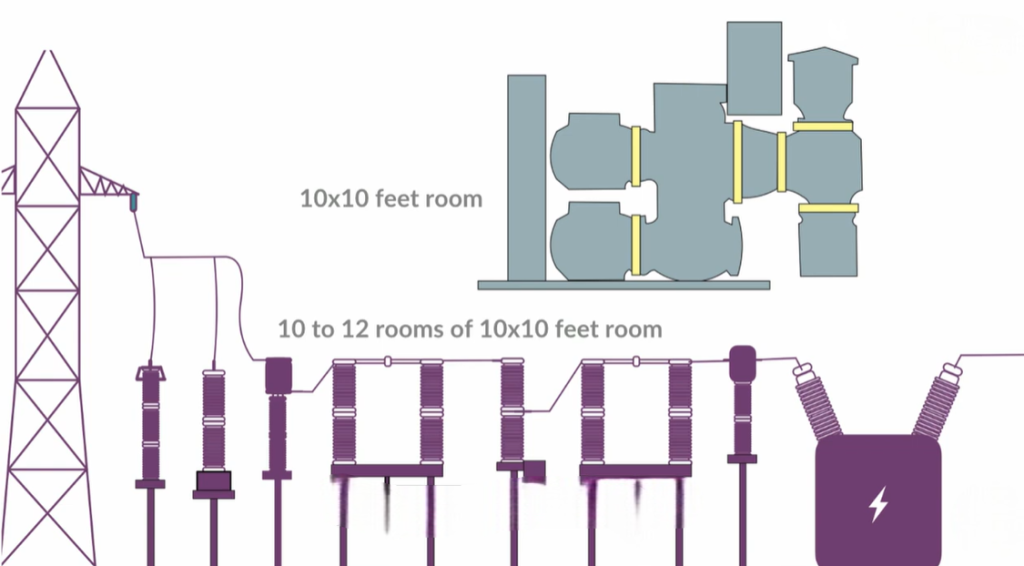
To fit the same rating in AIS, we would need 10 to 12 such rooms. The space savings are huge. It also becomes easier to manage the layout.
Why Compactness Matters in Cities
Compactness becomes more important in crowded cities. Land rates in cities like Mumbai are very high. Large substations need large plots. Buying such plots becomes expensive and almost impossible at times.
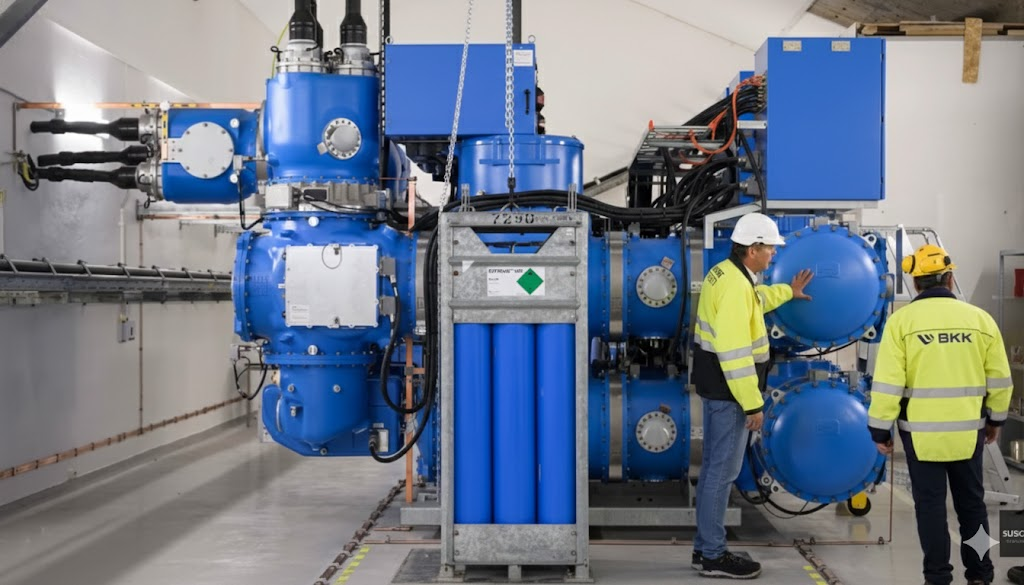
GIS solves this need. It fits inside a small building or a small room. So, utilities can place substations even in tight spaces. They can also install them inside buildings. This improves safety and aesthetics. The equipment stays covered, clean, and neat.
Moreover, compactness helps when power demand grows. Many old substations run out of space. They cannot expand because the land is fixed. In such cases, engineers can replace AIS with GIS. The size reduces. This frees up space for added bays. Then the same land can support more power demand.
The video shared one real example. A switchgear room once had AIS equipment. After replacing it with GIS, large free space appeared.
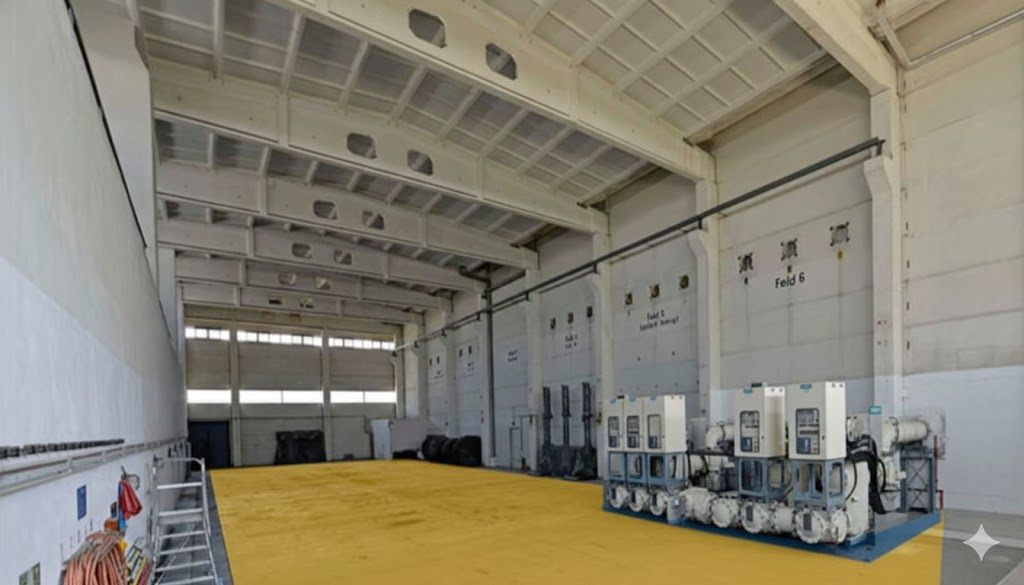
Engineers could then add more bays without buying new land. This makes GIS a practical solution for rising demand in cities.
Gas Insulated Switchgear (GIS) Performs Well in Harsh Environments
Another key advantage of Gas Insulated Switchgear (GIS) is its strong performance in harsh environments. AIS equipment stands open in air. Dust, dirt, pollution, and moisture affect its insulators. If these contaminants build up on surfaces, they can cause flashovers. This creates breakdowns and failures. To avoid this, AIS needs regular maintenance. Line crews must wash the insulators often. This is called hot-line washing. It adds cost and effort.
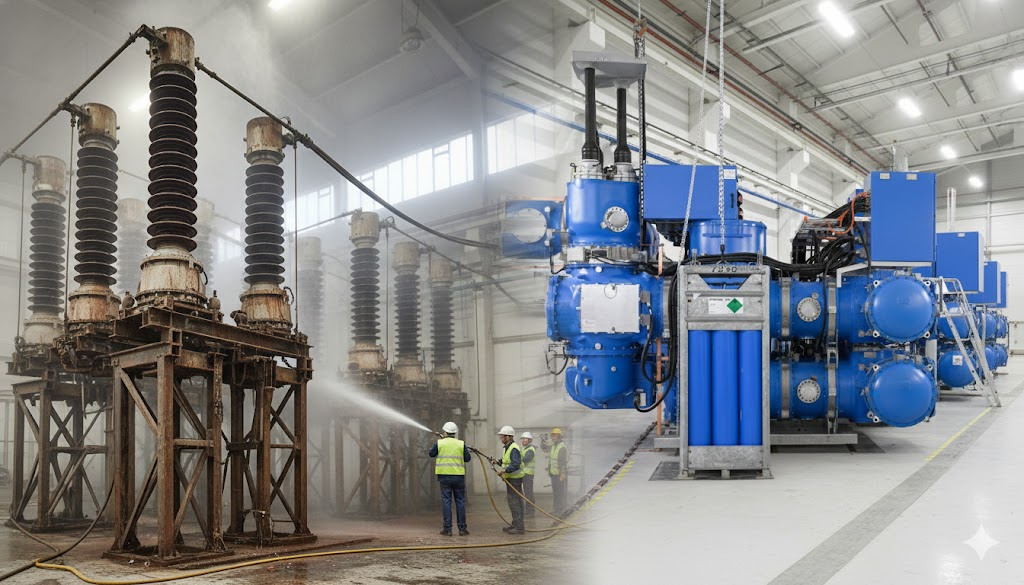
GIS avoids this problem. All live parts stay enclosed inside a metal housing. The gas inside the chamber insulates the equipment. No dust or dirt enters the enclosure. Pollution does not settle on the parts. The equipment stays protected from every atmospheric condition.
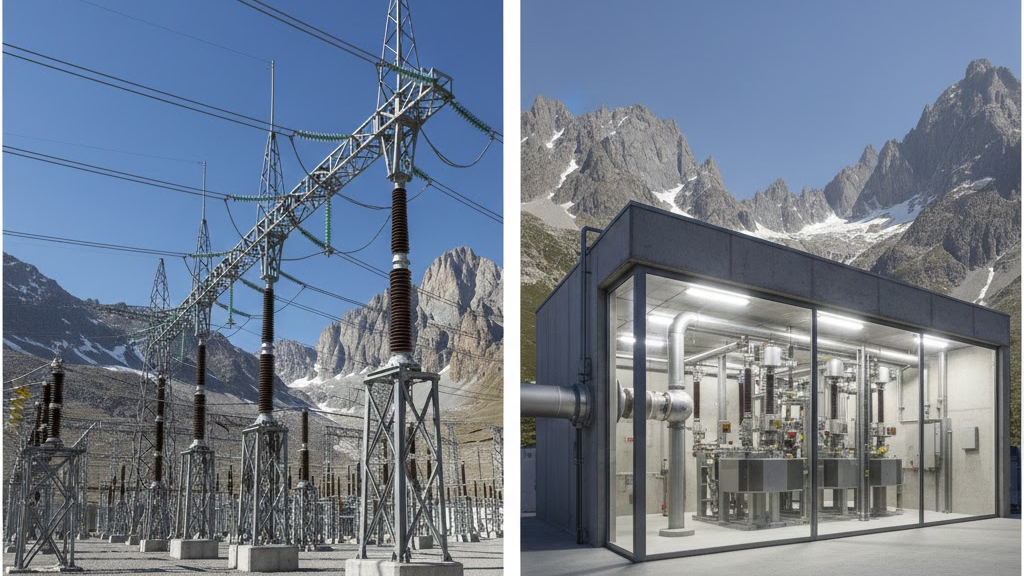
This protection makes GIS the best choice for industries with high pollution. A cement plant has heavy dust. Coastal regions have salty air with high moisture. Desert areas have fine particles. All these conditions demand more care for AIS. GIS needs almost none. It works smoothly even in extreme climates.
Gas Insulated Switchgear (GIS) Has No Altitude Impact
Altitude affects AIS. At high altitudes, the density of air decreases. When air becomes thin, its dielectric strength drops. Engineers must then use higher-rated insulation for AIS systems. Sometimes they even shift to a higher voltage class to meet the insulation needs.
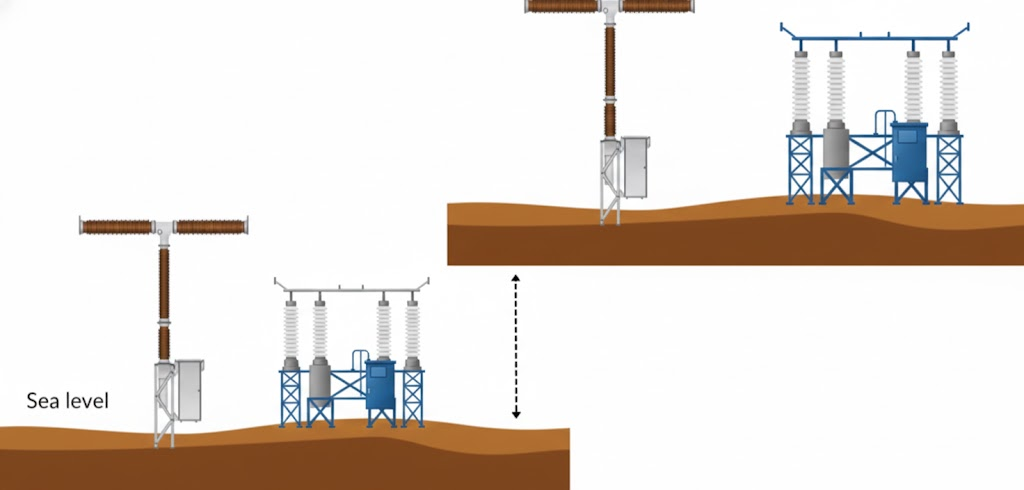
GIS does not face this issue. The gas inside the chamber stays constant. Air outside has no role in insulation. So, high altitude does not disturb most parts of GIS. The only exception occurs in the air-to-SF6 bushings.
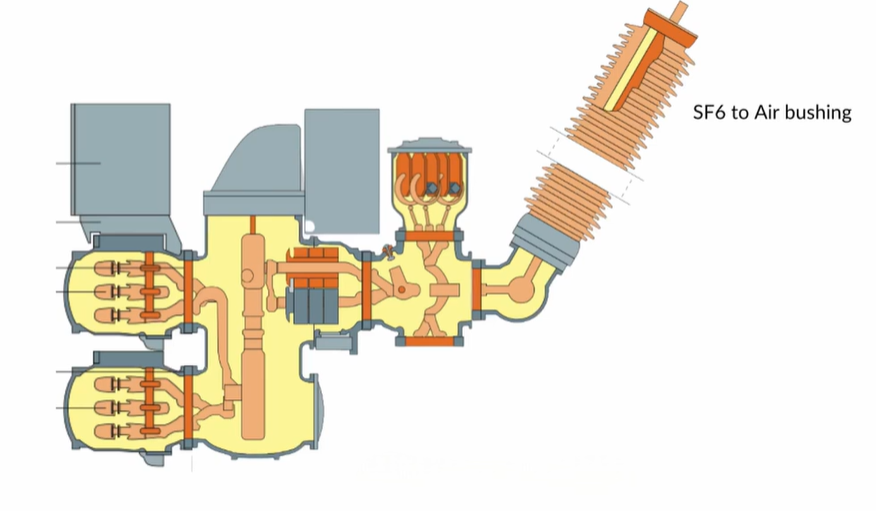
These bushings connect GIS to outdoor air. Air density still affects these parts. However, the rest of the equipment remains stable. This is why GIS is more suitable for mountain areas.
Advantages of Gas Insulated Switchgear (GIS) in Reliability and Maintenance
Reliability is one of the strongest advantages of Gas Insulated Switchgear (GIS). It became more reliable due to continuous upgrades over the last 50 years. The design is stable and predictable. The enclosure protects every part from the environment. This reduces stress on the system.
GIS needs very little maintenance. AIS needs regular checks and cleaning. Dust and moisture increase failure risks in AIS. GIS avoids these issues because everything stays sealed.
The first visual inspection in GIS usually happens after 5 to 8 years. Major inspections normally happen after 20 to 25 years. This long gap shows how reliable the system is. Utilities save time and money because they do not need frequent checks. They also do not worry about unplanned outages for cleaning.
Reduced Environmental Impact Through Low Land Use
Another notable advantage of GIS is its reduced impact on the environment. AIS requires large plots. Many times, these plots come from forest or green land. Trees must be cut. Land must be cleared. This affects the environment.
GIS needs very little space. It fits inside a small room or a compact building. So, companies reduce land requirements. This lowers the need for clearing green areas. Even though GIS uses SF6 gas, which has its own concerns, the land-saving benefit is important. The video clearly states that SF6 is a separate issue. But the focus here is on the environmental benefit achieved by saving land.
In many projects, smaller land use is a major advantage. It also helps planners protect natural spaces. Utilities can install GIS inside existing structures and avoid disturbing nature.
Gas Insulated Switchgear (GIS) Is Much Safer
Safety is another major advantage of Gas Insulated Switchgear (GIS). GIS uses a dead-tank design. The outer body remains at ground potential. Even if someone touches it by mistake, nothing happens. Touching is not recommended, but accidents can occur. In such cases, GIS does not harm the person because the surface is not live.
All live parts stay inside a metallic enclosure. This reduces risks. AIS also follows safety rules, and around 70 percent of global substations still use AIS. So AIS is safe too. Yet, when we compare both, GIS provides more safety because live parts are fully covered and never exposed to open air.
The sealed design also prevents accidental contact. It removes risks from pollution, weather, and animals. This makes GIS a very dependable and safe technology for indoor and outdoor use.
Why These Advantages Make GIS a Popular Choice
When we look at all the advantages together, GIS becomes a strong option for modern power networks. Its compactness solves land problems in crowded cities. Its sealed design protects systems in harsh climates. High altitude does not reduce performance. Low maintenance makes it reliable. Its enclosed structure improves safety. It also helps reduce land impact.
More industries and utilities now move toward GIS for these reasons. Cities expand fast. Pollution increases. Land becomes expensive. So, GIS stays one of the best choices for the future.
Summary of Key Advantages of Gas Insulated Switchgear (GIS)
Below is a quick recap of all the points covered, in the exact flow of the source content:
1. GIS Is Not New but Very Reliable
It has been in use for over 50 years. Continuous improvements made it stable and proven.
2. GIS Offers Super Compactness
It saves huge space compared to AIS. A 145 kV GIS bay fits inside a single small room.
3. Compactness Helps in Cities
High land cost makes AIS difficult. GIS fits inside buildings and frees up land.
4. Ideal for Harsh Environments
Dust, dirt, pollution, and salt do not affect GIS. AIS needs frequent washing. GIS does not.
5. No Altitude Impact
Thin air affects AIS insulation. GIS insulation stays stable inside its enclosure.
6. Very Low Maintenance
Visual checks start after 5 to 8 years. Major inspection after 20 to 25 years.
7. Lower Environmental Land Impact
GIS needs less land, so fewer trees need removal.
8. More Safety
Dead-tank design keeps the outer body at safe potential.
All these points reflect the flow of the original video script. No extra points outside the transcript are added.
Conclusion
Gas Insulated Switchgear (GIS) brings many strong advantages in size, safety, reliability, and environmental impact. It is not new technology. Yet, its steady improvement made it one of the best choices today. It works well in cities, harsh climates, and high altitudes. It also reduces maintenance needs and improves safety. All these factors explain why many utilities now choose GIS. For a clearer understanding, you can watch the original video.

