


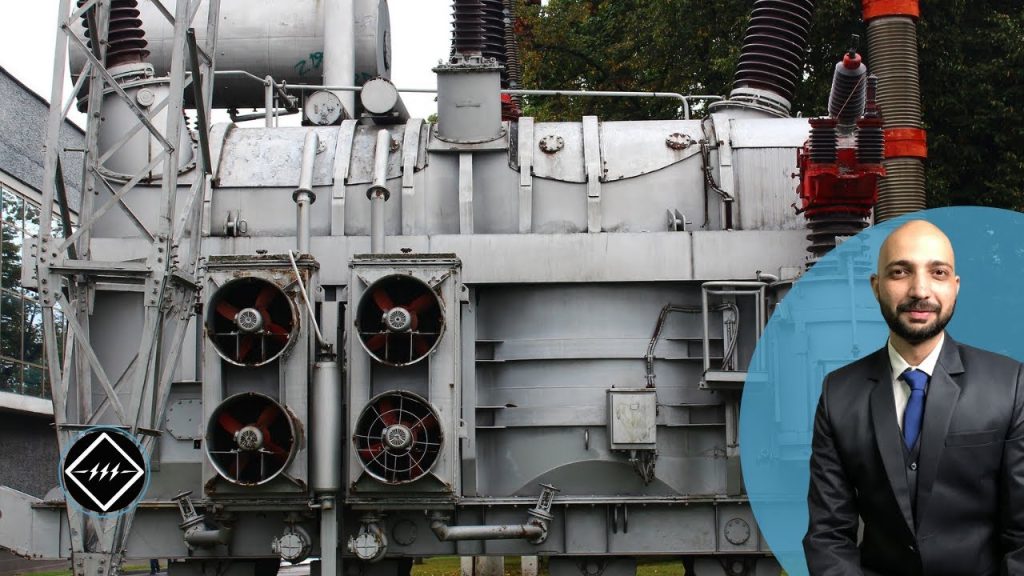
Top 5 Causes of Power Transformer Failures in Substations
Top 5 Causes of Power Transformer Failures in Substations https://www.theelectricalguy.in/wp-content/uploads/2026/02/maxresdefault-1024x576.jpg 1024 576 Gaurav Joshi https://secure.gravatar.com/avatar/f6a3006f3f7233a71d79d0e705c167ae12516870e5239627478665ae377435b3?s=96&d=mm&r=gMost transformer failures do not happen suddenly. They develop quietly over time. Sometimes this takes weeks. In many cases, it takes months or even years. Then, one day, the transformer announces that it is done. A catastrophic failure occurs.
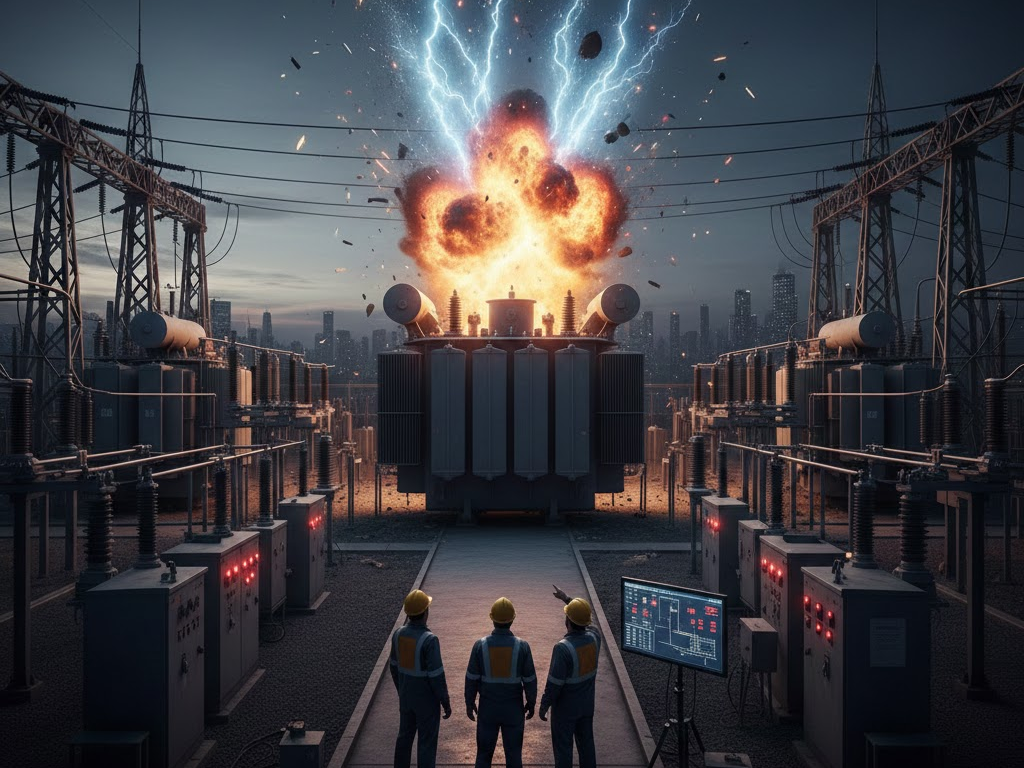
We are not talking about a small device. A power transformer is the most expensive equipment in a substation. When it fails, the impact is serious. If you have ever been on-site when a transformer trips, you know the feeling. One moment, everything looks normal. The next moment, alarms appear, protection flags rise, and the system shuts down. This shutdown can cost lakhs or even crores per hour.
That is why understanding failures is essential. In this article, we will discuss the five major causes of electrical transformer failures. These causes appear repeatedly in reports from IEEE, CIGRE, and major utilities. They also match real failure databases and reliability surveys. This is not theoretical knowledge. It is based on real industry experience.
Let us now examine these causes step by step.
Insulation Breakdown in Electrical Transformers
Oil and Paper Aging, Moisture, and Contamination
First and foremost, the most important cause of power transformer failure is insulation breakdown. In reality, a power transformer functions mainly as an insulation system. Although copper and steel are important, insulation ultimately decides how long the transformer will survive.
Solid insulation consists of paper and pressboard. Liquid insulation consists of oil or ester. Once insulation strength begins to fall in a power transformer, failure becomes inevitable. At that stage, the only question is when it will happen.
Insulation deteriorates mainly due to heat, moisture, oxidation, and contamination. Heat is produced by overloading, poor cooling, and hot spots. High temperature accelerates chemical aging. Moisture enters from aging paper, leaks, poor drying, or breathing problems. Moisture reduces dielectric strength significantly.
Over time, oxidation creates sludge and increases oil acidity. As a result, acidic oil attacks paper insulation. In addition, contamination introduces conductive particles into the oil, such as carbon, metal debris, or dust. Together, these factors gradually weaken insulation paths.
As this process continues, several technical indicators begin to change. For example, the paper degree of polymerization falls, while oil acidity rises. At the same time, interfacial tension drops and dielectric strength reduces. Consequently, partial discharge becomes more likely. Eventually, arcing may start, and winding-to-ground faults can occur.
Warning Signs and Prevention Mindset
Some signs indicate insulation stress. These include:
- Rising moisture content in oil
- Increasing oil acidity and decreasing IFT
- Hot spot temperature alarms
- Repeated overload history
These indicators should never be ignored. Insulation failure is rarely caused by bad luck. In most cases, it results from missed monitoring or ignored trends.
Industry failure studies show that insulation stress builds slowly. Many transformers are removed only when the risk becomes clearly unsafe. A strong prevention mindset helps avoid such situations. Regular testing and trend analysis allow early intervention.
Winding Faults and Internal Short Circuits
Shorted Turns and Mechanical Damage
The second major cause is winding failure in a power transformer. Winding faults may include turn-to-turn shorts, phase-to-phase faults, or winding-to-ground faults. These faults are dangerous because they escalate very quickly.
Once a winding fault starts, it releases massive energy inside the power transformer. This energy damages insulation, conductors, and structural parts. As a result, the failure spreads rapidly.
Two main paths lead to winding failure in a power transformer. The first is insulation weakness. This directly links to the first cause. Weak insulation allows electrical faults to develop.
The second path is mechanical damage. This usually occurs during external short circuits. When a short circuit happens, current rises sharply. This produces strong electromagnetic forces. These forces try to move the windings physically.
When bracing is weak, movement begins. Aged supports allow deformation to develop. Loose clamping reduces stability. Over time, this deformation damages insulation. Eventually, internal short circuits form.
Large utility databases confirm this pattern. Winding and shorted-turn failures appear frequently. They remain among the most reported causes.
Warning Signs of Winding Problems
Winding problems usually show early symptoms, such as:
- Differential protection operation
- Sudden gas relay activation
- DGA spikes, depending on fault type
- Unexpected impedance changes
- Abnormal excitation current
These signals indicate internal stress. Engineers should investigate them immediately. Early diagnosis prevents major damage.
Bushing Failures in Power Transformers
Electrical Stress and Environmental Exposure
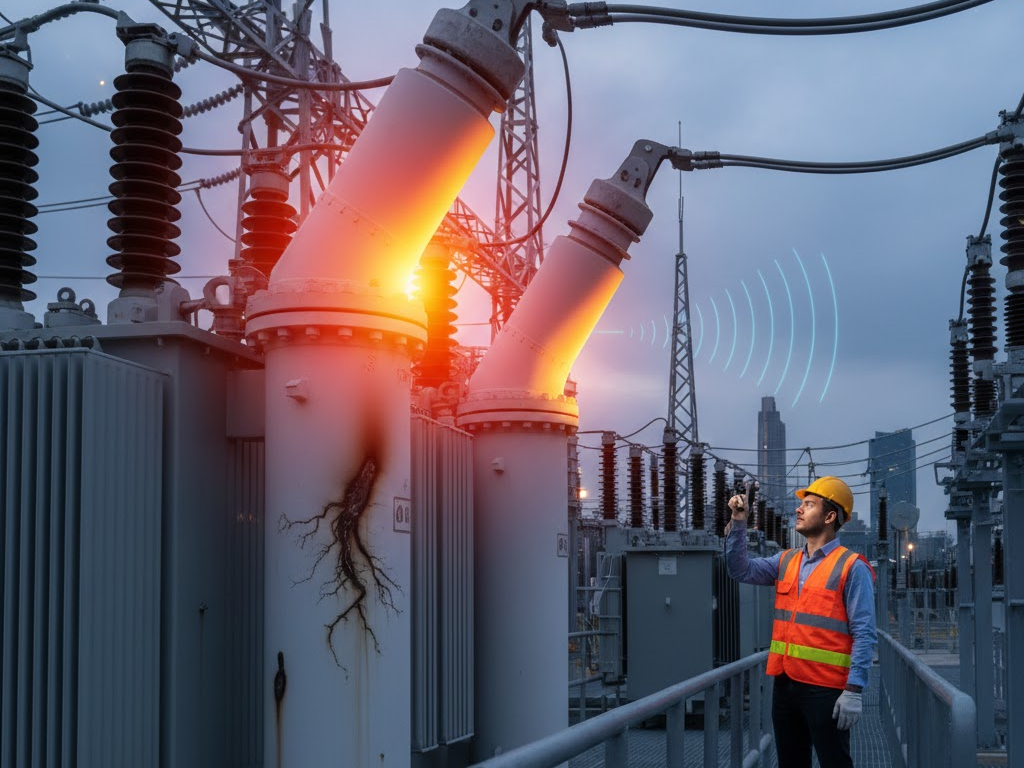
If one component fails in a dramatic way in a power transformer, it is the bushing. Bushing failures often look sudden. They may cause fire or tank rupture. However, damage usually develops slowly.
A bushing in a power transformer is not just a terminal. It is a complex insulation system designed to withstand harsh operating conditions. Exposure to weather, thermal cycling, and switching surges places it under continuous stress, along with high electrical loading.
Several mechanisms cause bushing failure in a power transformer. Moisture ingress is common. It enters through aged seals or damaged gaskets. Partial discharge may develop inside insulation layers. Oil leaks affect oil-impregnated paper bushings. Reduced oil weakens insulation.
Overheating at connections also contributes. Loose clamps increase resistance. Poor contact pressure generates heat. Surface contamination creates tracking paths. Salt fog and pollution accelerate flashover.
Utility failure data shows that bushing failures are leading causes in some populations. In certain manufacturing decades, they even dominate failure statistics.
Warning Signs of Bushing Problems
Bushing deterioration produces several visible signs:
- Increasing tan delta and capacitance changes
- Hotspots detected by infrared cameras
- Audible noise near terminals
- Visible tracking or puncture marks
- Sudden catastrophic rupture in severe cases
Regular monitoring helps detect these problems early.
OLTC Problems in Electrical Transformers
Arcing, Contact Wear, and Oil Contamination
The fourth major cause involves on-load tap changers. OLTCs adjust transformer taps while the load is live. This helps control system voltage. However, it also creates continuous electrical stress.
Tap changing involves switching under current. Therefore, arcing occurs during normal operation. Repeated arcing slowly erodes contacts. Over time, contact resistance increases. Heating becomes severe.
Several factors lead to OLTC failure:
- Contact erosion and rising resistance
- Carbonization and oil contamination
- Mechanical wear and misalignment
- Poor timing during switching
- Inadequate maintenance practices
These problems reduce switching reliability. They also increase fire and fault risk.
Failure surveys show that OLTC issues appear among leading causes. They rank after winding and bushing failures.
Warning Signs of OLTC Problems
OLTC issues often produce noticeable symptoms, such as:
- Voltage regulation instability
- Abnormal tap position behavior
- Mechanical irregularities during operation
- Excessive temperature rise in selector paths
Ignoring these signs increases failure probability. OLTC health requires constant attention.
Thermal Overload and Cooling System Failures
Fans, Pumps, Radiators, and Airflow Issues
The fifth major cause is thermal overload and cooling failure. This cause is very common. Yet many engineers underestimate its impact.
Many failures start with small issues. A fan may not start. A pump may trip. A radiator valve may stick. Filters may clog. Ventilation may reduce.
Despite these problems, the transformer keeps running. It operates hotter each day. Gradually, insulation aging accelerates.
Heat accelerates aging exponentially. Even small temperature increases reduce insulation life significantly. The practical rule is simple. A hotter transformer ages faster.
Common real-world triggers include:
- Failed fans or pumps without proper alarms
- Incorrect cooling control settings
- Radiator blockage due to dust
- Poor ventilation or installation constraints
- Overloading beyond nameplate rating
- Loss of oil circulation
- Low oil level
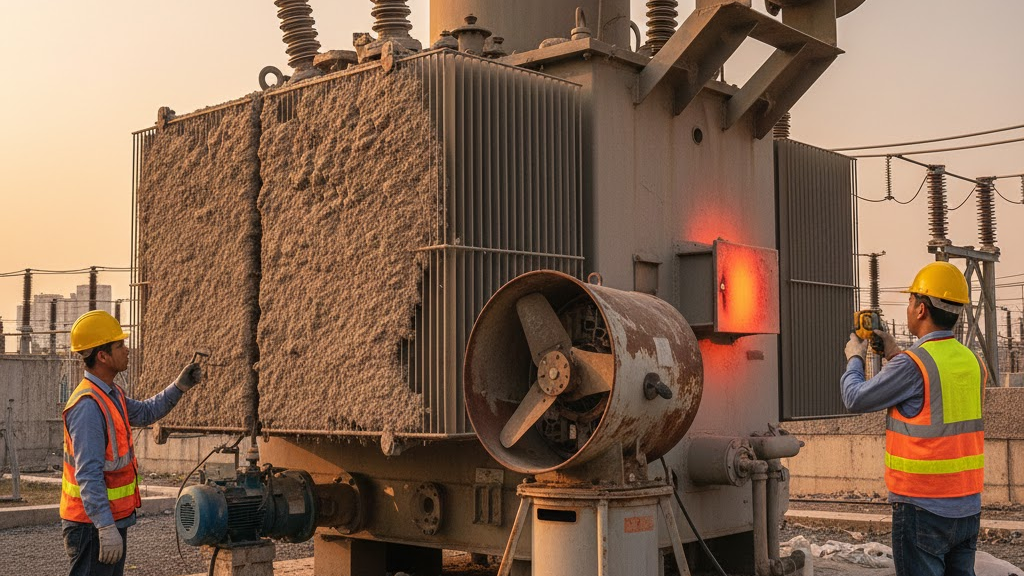
In many failure records, cooling loss appears under “other causes.” It rarely appears as the final reason. However, it silently drives insulation collapse.
Summary: The Five Major Causes of Electrical Transformer Failures
Let us quickly review the five main reasons for transformer failure.
The first cause is insulation breakdown. This involves oil aging, paper degradation, moisture, and contamination.
The second cause is winding faults. These include shorted turns and internal short circuits.
The third cause is bushing failure. This results from moisture, discharge, overheating, and pollution.
The fourth cause is OLTC failure. This develops due to arcing, wear, and oil contamination.
The fifth cause is thermal overload. Cooling system problems and overloading drive this issue.
These failures do not appear suddenly. They develop slowly over long periods. Most catastrophic events represent the final stage of long deterioration.
Conclusion
Major causes of electrical transformer failures follow clear patterns. They involve insulation stress, mechanical damage, surface degradation, switching wear, and thermal aging. These problems grow silently over time.
Tracking condition indicators helps prevent failures. DGA trends reveal internal faults. Moisture levels show insulation health. Bushing tan delta indicates aging. Temperature trends reveal cooling issues. OLTC diagnostics show contact wear.
Early detection saves equipment and reduces downtime. It also protects investments and improves system reliability.
For better understanding, visual learning is very helpful. The referenced video explains these failures using real examples. Watching it will improve practical understanding and technical clarity.

