


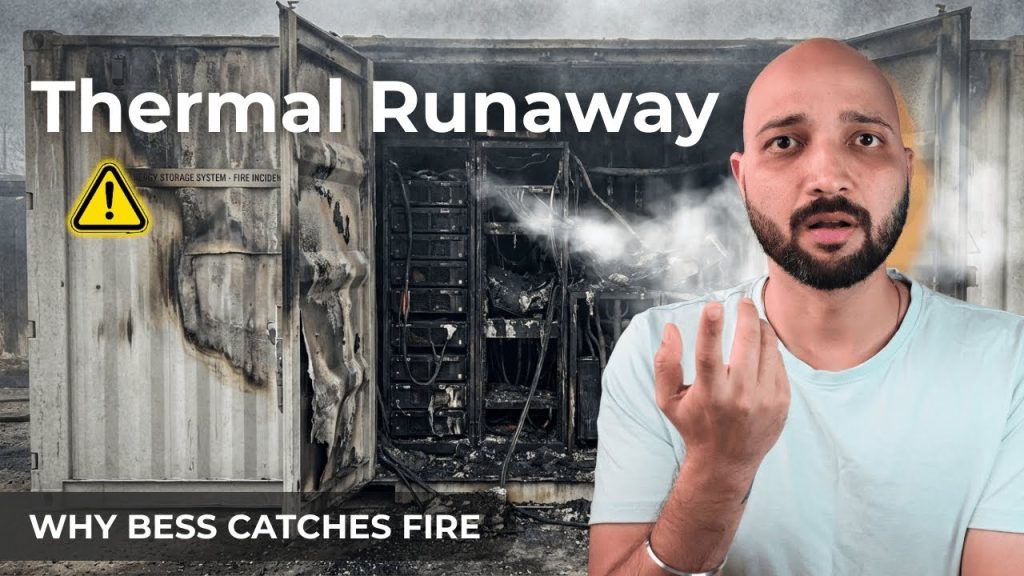
What is Thermal Runaway in Battery Storage?
What is Thermal Runaway in Battery Storage? https://www.theelectricalguy.in/wp-content/uploads/2026/01/maxresdefault-1-1024x576.jpg 1024 576 Gaurav Joshi https://secure.gravatar.com/avatar/f6a3006f3f7233a71d79d0e705c167ae12516870e5239627478665ae377435b3?s=96&d=mm&r=gIn September 2020, a battery energy storage system in Liverpool, UK, caught fire. The fire did not stop quickly. It burned for almost 59 hours. Thick smoke filled the air, followed by a explosion. One battery container was destroyed. When investigators completed their analysis, the cause was clear. The incident was triggered by a thermal runaway.
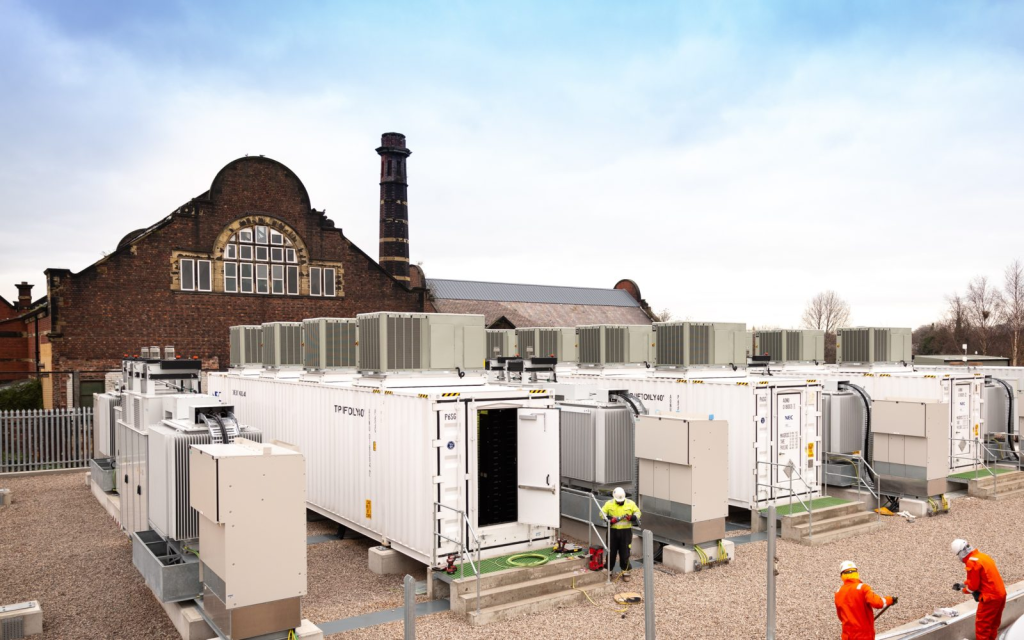
This was not a one-time failure. Similar battery storage fires have occurred across the world. Incidents in Arizona and Australia followed the same pattern. These events shocked the energy storage industry. They also raised serious concerns among investors and regulators.
Large-scale battery storage remains critical for renewable energy goals. Grids depend on it for stability and flexibility. However, the fear of fire remains one of the biggest reasons investors hesitate. To address this risk, it is essential to understand why battery storage systems catch fire and how thermal runaway unfolds.
Table of Contents
- What Thermal Runaway Means in Battery Storage Systems
- Battery Compromise: The First Step in Why Battery Storage Systems Catch Fire
- Offgassing: The Silent Warning Before Battery Storage Fires
- Smoke Production and the Start of Thermal Runaway
- Fire and Explosion in Battery Storage Systems
- What Triggers Thermal Runaway in Battery Storage Systems
- Why One Hot Cell Causes Battery Storage Fires
- How Engineers Prevent Battery Storage Systems Catch Fire
- Conclusion: Why Battery Storage Systems Catch Fire
What Thermal Runaway Means in Battery Storage Systems
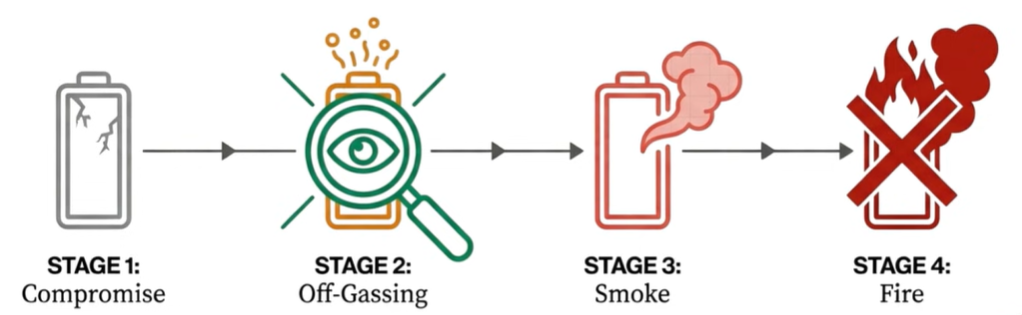
Thermal Runaway is not an instant explosion. It is a process that develops in stages. Each stage builds on the previous one. Once the process starts, it becomes harder to stop with time.
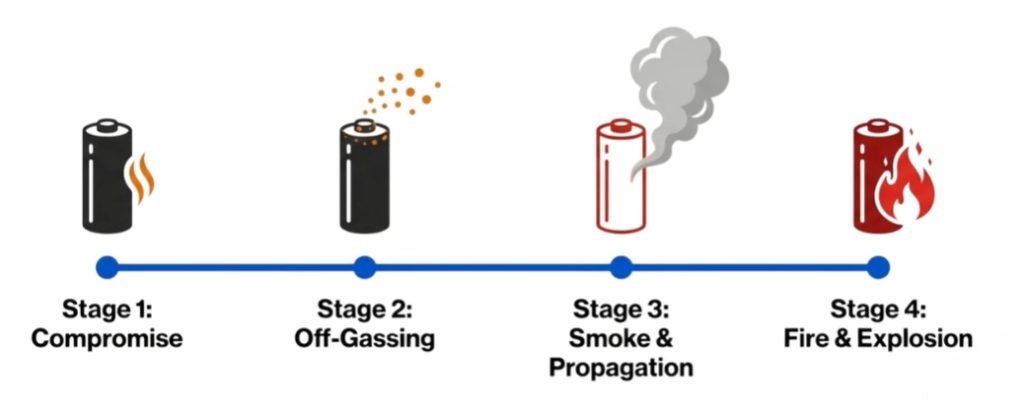
To understand thermal runaway, we must look inside a lithium-ion battery cell. Inside the cell, chemical reactions generate energy. These reactions are stable only within a limited temperature range. When the temperature rises beyond this range, the chemistry becomes unstable. This instability sets the stage for failure.
Thermal Runaway always follows a clear sequence. The key to prevention lies in recognizing these stages early.
Battery Compromise: The First Step in Why Battery Storage Systems Catch Fire
The first stage of thermal runaway is called battery compromise. This stage often goes unnoticed because there are no visible signs.
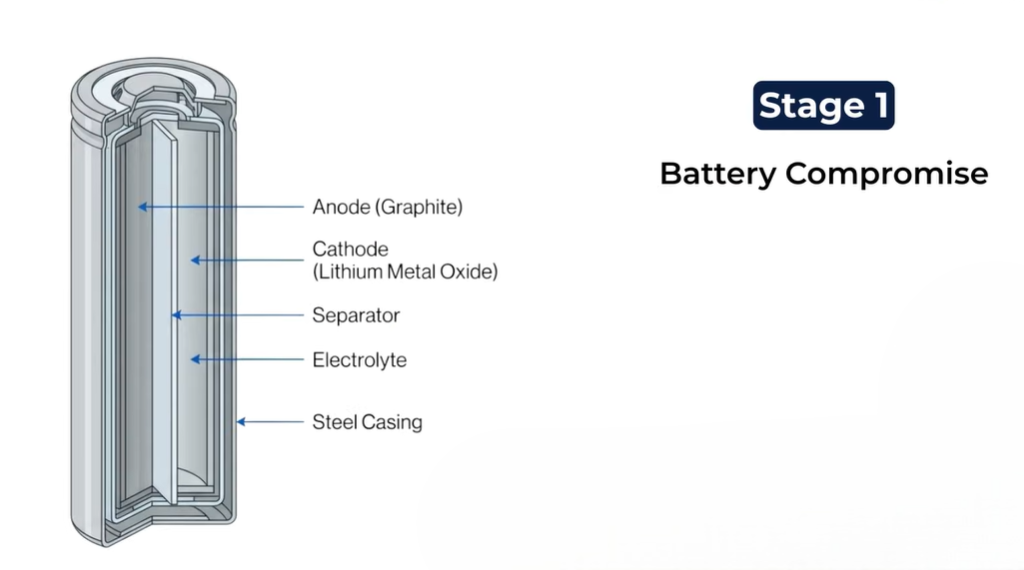
Battery compromise can begin due to several reasons:
- Overheating of the cell
- Overcharging beyond safe voltage limits
- A small internal short circuit
- Manufacturing defects that are not visible externally
In each case, the same thing happens inside the cell. The temperature begins to rise. As the cell moves beyond its safe operating range, the internal chemistry becomes unstable. The electrolyte, which is a flammable liquid, starts to break down. Pressure slowly builds inside the cell casing.
At this stage, there is no fire and no smoke. However, the cell is already under stress. If no corrective action is taken, the process moves to the next stage.
Offgassing: The Silent Warning Before Battery Storage Fires
The second stage is known as offgassing. As pressure inside the cell continues to rise, the casing can no longer contain it. The cell vents and releases gas into the battery container.
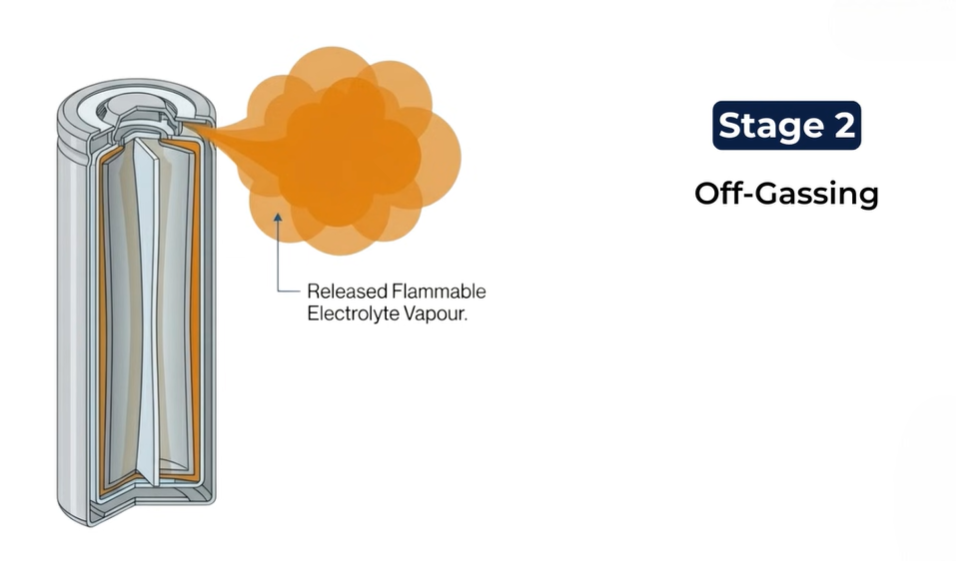
This gas is not harmless smoke. It is vaporized electrolyte mixed with flammable compounds. Offgassing is especially dangerous because it can continue quietly for 10 to 30 minutes. During this time, there may be no flames, no sound, and no visible smoke. Meanwhile, the container slowly fills with combustible gases.
This stage offers the best opportunity to prevent a disaster. Gas detection systems can identify offgassing before visible signs appear. If detected early, operators can shut down the affected rack, isolate faulty modules, and activate ventilation systems. These actions can stop the chain reaction before it escalates.
If offgassing goes unnoticed, the risk increases rapidly.
Smoke Production and the Start of Thermal Runaway
The third stage marks the true beginning of thermal runaway. At this point, the internal structure of the battery cell breaks down completely.
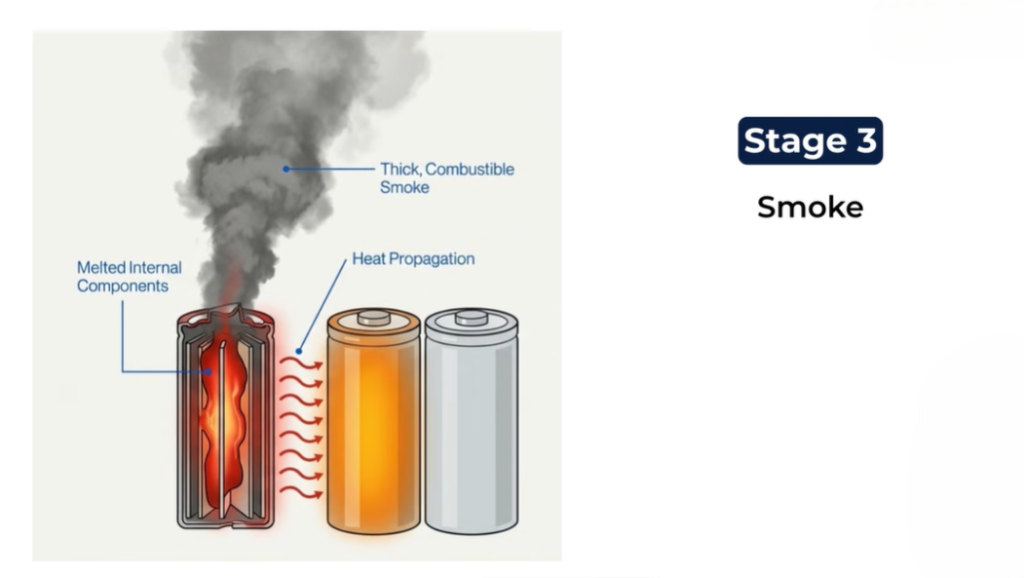
The anode and cathode short circuit inside the cell. Temperatures rise beyond 300 degrees Celsius. Smoke begins to form from within the battery. This smoke is highly combustible and extremely dangerous in enclosed containers.
Heat from the failing cell spreads to neighboring cells. Those cells fail in the same way. This creates a chain reaction where one failing cell triggers the next. The process continues across modules and racks.
In sealed containers, smoke and gases accumulate rapidly. This creates explosive conditions. The Arizona incident followed this exact pattern. When firefighters opened the container door, fresh oxygen rushed in. The result was a massive explosion.
Fire and Explosion in Battery Storage Systems
The final stage involves fire or explosion. Flames may appear, but they are not always visible. Even without flames, the container atmosphere remains highly explosive.
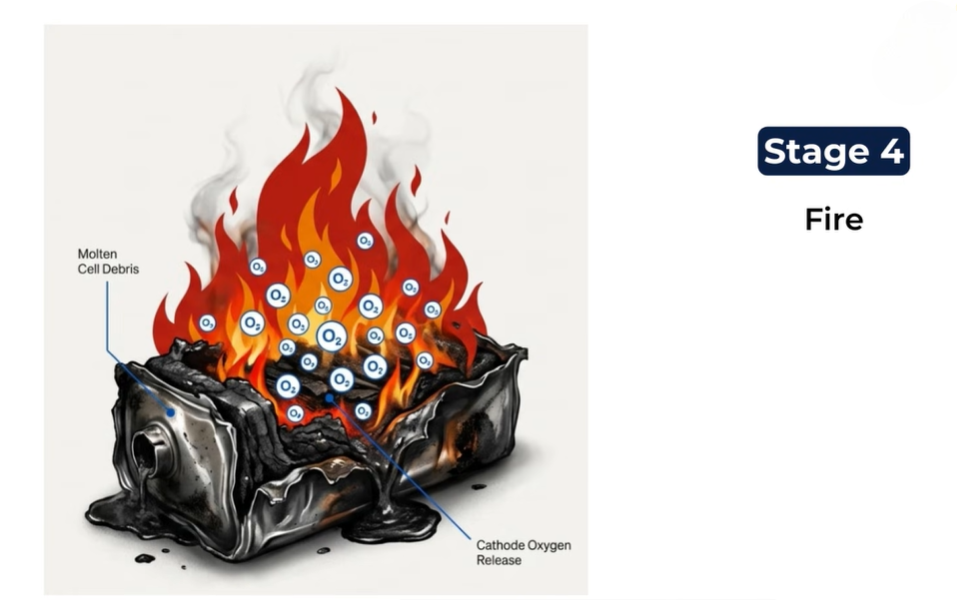
By this stage, the container is filled with:
- Hydrogen
- Carbon monoxide
- Vaporized electrolyte
If ignition occurs, the fire becomes self-sustaining. The cathode material releases oxygen as it burns. This means the fire no longer depends on external oxygen. Disconnecting power at this point does not stop the reaction.
This explains why some battery storage fires burn for days. The Megapack fire in Australia burned for four days. Firefighters chose to let it burn out while protecting nearby assets, as active suppression offered limited benefit.
What Triggers Thermal Runaway in Battery Storage Systems
Several internal conditions can trigger thermal runaway. In every case, heat is the common factor.
Overcharging removes too many lithium ions from the cathode. This damages its crystal structure and reduces stability. Charging at very low temperatures can cause lithium plating. Thin metallic layers form and grow into sharp dendrites. These dendrites can pierce the separator and cause internal short circuits.
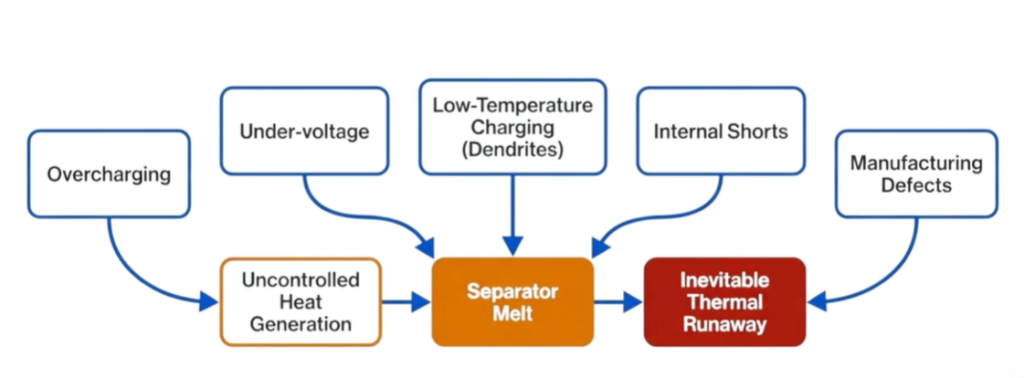
Undervoltage also creates risks. When a battery is discharged too deeply, copper dissolves from the current collector. This copper moves through the electrolyte and deposits elsewhere as metal. These deposits can cause short circuits.
Each of these scenarios leads to heat buildup. Once the separator melts, short circuits become direct and violent. At that point, thermal runaway becomes unavoidable.
Why One Hot Cell Causes Battery Storage Fires
Battery packs rarely fail because all cells heat up together. Failure usually starts with one weak cell.
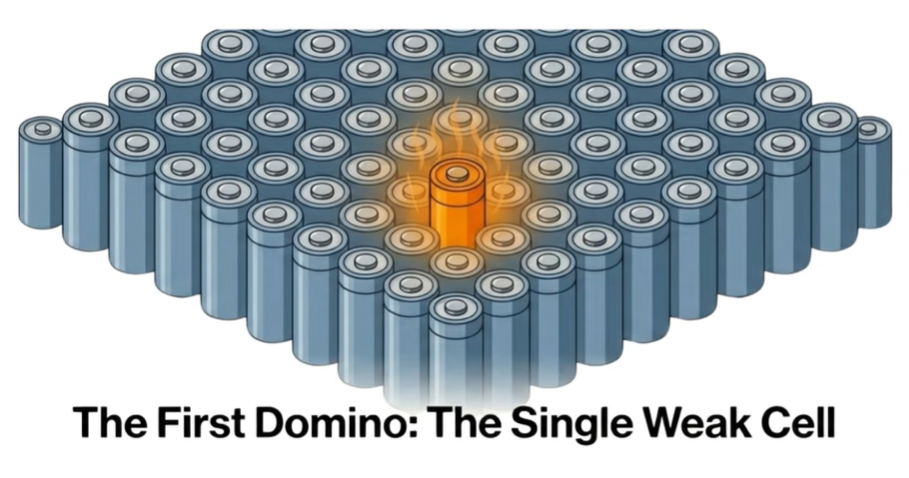
That cell ages faster than the others. Its internal resistance increases. As resistance rises, it generates more heat. This single hot cell becomes the trigger for thermal runaway.
Uneven temperature distribution plays a major role. Poor cooling allows some cells to run hotter than others. Many real-world failures have shown this pattern. Air cooling often cannot remove heat fast enough. For this reason, modern grid-scale systems rely on liquid cooling to maintain uniform temperatures across cells.
How Engineers Prevent Battery Storage Systems Catch Fire
Preventing battery storage fires requires multiple layers of protection. No single system can eliminate all risks.
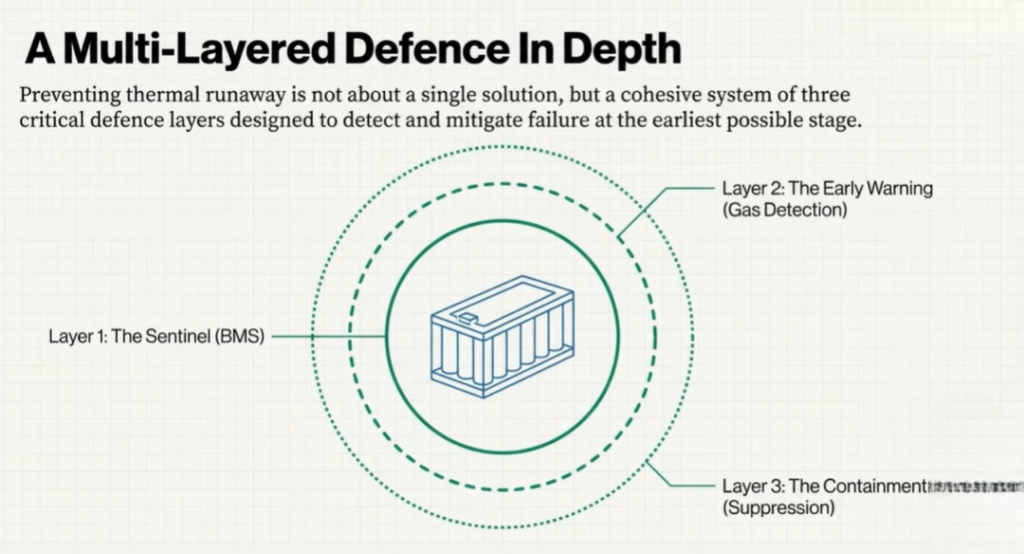
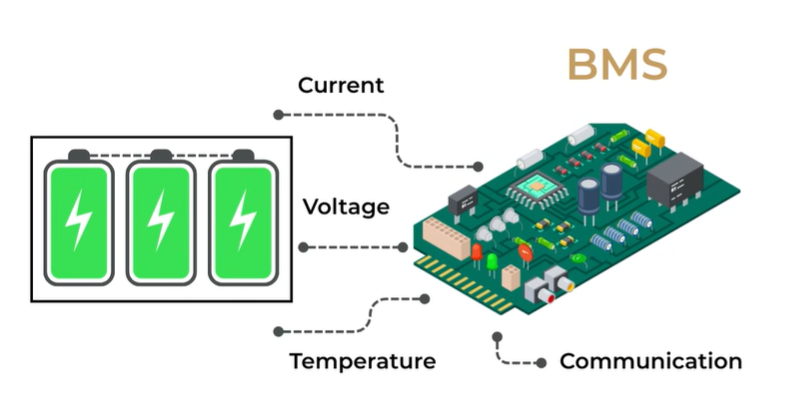
The first line of defense is the battery management system. The BMS monitors voltage, current, and temperature at the cell level. It prevents overcharging and undervoltage. It also shuts down the system when abnormal conditions appear.
However, the BMS cannot detect chemical changes inside a cell. This is why gas detection forms the second line of defense. Early detection of offgassing provides critical response time. Operators can isolate faulty racks and activate ventilation before smoke forms.
Fire suppression systems form the final layer. Their purpose is containment, not complete extinguishment. These systems aim to reduce oxygen levels, slow fire spread, and buy time for stabilization.
Conclusion: Why Battery Storage Systems Catch Fire
Battery storage fires may appear sudden, but they always follow a clear pattern. A compromised cell leads to offgassing. Offgassing leads to smoke. Smoke leads to fire or explosion.
The most important goal for engineers is early detection. Identifying problems during the offgassing stage can prevent catastrophic outcomes.
If you want a deeper and clearer understanding of how grid-scale battery energy storage systems work in real projects, I recommend checking out my course on grid-scale battery energy storage systems for professionals. The course starts from the fundamentals and moves into real-world engineering applications. It covers system architecture, sizing, and practical design considerations used in actual projects.
If this topic interests you, watching the video will also help you understand thermal Thermal Runaway visually and in more detail.
