

What is HVDC Transmission?
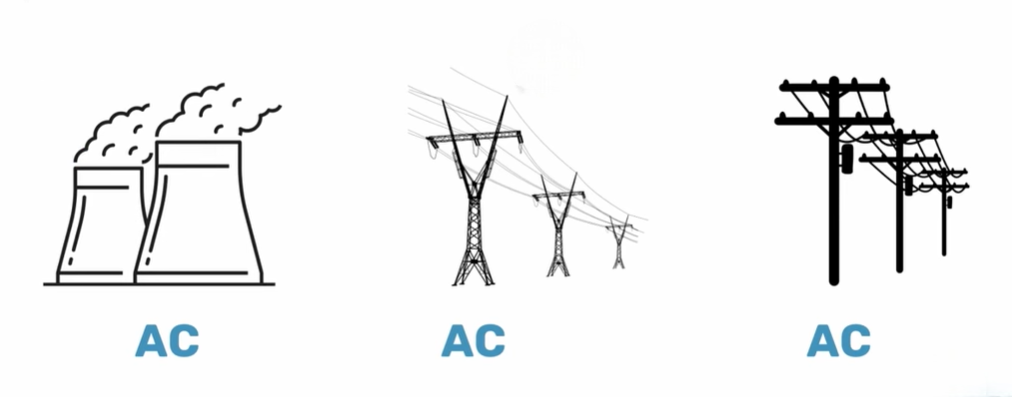
What is HVDC Transmission? https://www.theelectricalguy.in/wp-content/uploads/2025/12/maxresdefault-6-1024x576.jpg 1024 576 Gaurav Joshi https://secure.gravatar.com/avatar/f6a3006f3f7233a71d79d0e705c167ae12516870e5239627478665ae377435b3?s=96&d=mm&r=gElectric power systems across the world mainly operate on alternating current. Electricity is generated in AC form, transmitted using AC networks, and finally distributed to consumers as AC power. This system offers several advantages and has proven reliable for decades. There is no doubt that AC transmission works well for most applications.
However, there are certain scenarios where AC transmission reaches its limits. These limitations make it difficult to transmit large amounts of power over long distances or connect different power systems safely. In such situations, high voltage direct current becomes a better option. This article provides a clear Introduction to HVDC Transmission, explaining why it is needed, how it works, and where it is used.
Table of Contents
- Why We Need HVDC Transmission
- Limitations of HVAC Transmission
- How HVDC Transmission Solves These Problems
- Basic Working of HVDC Transmission
- Advantages of HVDC Transmission
- Cost Considerations in HVDC Transmission
- Real-World HVDC Transmission Projects
- Importance of Offshore HVDC Transmission
- Choosing Between HVAC and HVDC Transmission
- Conclusion
Why We Need HVDC Transmission
AC transmission remains the backbone of power systems. Still, it cannot handle every situation efficiently. Physical and system-related constraints limit how far and how much power AC lines can transmit. These constraints increase losses and reduce system stability.
HVDC transmission helps overcome these challenges. It provides solutions where AC transmission struggles. To understand this clearly, it is important to look at the key limitations of HVAC transmission.
Limitations of HVAC Transmission
Inductive and Capacitive Effects in AC Lines
Every AC transmission line contains inductive and capacitive elements. These elements are unavoidable and strongly affect system performance. As transmission distance increases, reactive power also increases. This limits how much real power the line can carry.
Because of these effects, AC transmission cannot support very long distances with high power levels. For example, transmitting 10,000 megawatts over a distance of 2,000 kilometers using AC is not practical. Voltage control becomes difficult, losses increase, and system stability reduces. These physical limits form one of the biggest challenges in AC transmission.
Difficulty in Interconnecting Large AC Systems
Connecting two strong AC systems is not easy. When large power networks are directly interconnected, short circuit levels rise sharply. These fault levels can exceed the breaking capacity of available circuit breakers.
In addition, such interconnections can create unwanted power flow paths. These flows may destabilize the system and lead to operational issues. Because of these risks, direct AC interconnection between large systems becomes impractical in many cases.
AC Systems with Different Frequencies
Frequency compatibility is essential in AC systems. Two AC networks must operate at the same frequency to connect directly. If one system operates at 50 Hz and another at 60 Hz, direct interconnection is not possible.

This frequency difference creates a major barrier to power exchange between regions or countries. In such cases, AC transmission cannot provide a solution, which makes HVDC transmission a valuable alternative.
How HVDC Transmission Solves These Problems
HVDC transmission avoids the limitations of AC systems by converting AC power into DC. Once converted, power travels as direct current over long distances. At the receiving end, it is converted back into AC before entering the grid.
This approach removes inductive and capacitive effects from the transmission line. It also allows power exchange between systems with different frequencies. As a result, HVDC becomes highly effective in complex transmission scenarios.
Basic Working of HVDC Transmission
Overview of HVDC System Structure
An HVDC system connects two AC networks through a DC link. At the sending end, a converter station converts AC power into DC power. This process is called rectification. The DC power then flows through transmission lines or cables.
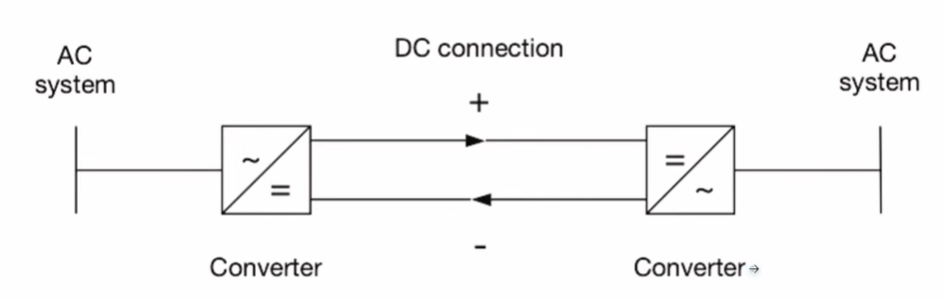
At the receiving end, another converter station converts DC power back into AC. This process is known as inversion. The converted AC power is then supplied to the receiving grid. This simple structure forms the foundation of HVDC transmission.
Role of Converter Stations in HVDC Transmission
Converter stations play a crucial role in HVDC systems. The sending-end station works as a rectifier, while the receiving-end station works as an inverter. These stations control power flow, voltage levels, and direction of transmission.
Although many systems operate inside converter stations, the basic purpose remains the same. They enable smooth conversion between AC and DC power, ensuring stable and efficient transmission.
Transmission Lines Used in HVDC
HVDC transmission uses only two conductors. One conductor carries positive voltage, and the other carries negative voltage. This is a key advantage compared to AC transmission, which requires more conductors.
Fewer conductors reduce material usage and simplify tower design. This also lowers the physical footprint of transmission lines, making HVDC more efficient in terms of infrastructure.
Bidirectional Power Flow in HVDC Transmission
HVDC systems allow power to flow in both directions. Power can move from the first AC system to the second or from the second back to the first. This flexibility does not require physical changes to the system.
The direction of power flow is controlled electronically through converter stations. This capability improves operational flexibility and supports changing power demands.
Advantages of HVDC Transmission
No Limitation on Transmission Distance
HVDC transmission eliminates inductive and capacitive effects in the line. As a result, there is no theoretical limit on transmission distance. In practice, HVDC systems already operate over distances exceeding 700 kilometers.
This makes HVDC ideal for long-distance bulk power transfer. It is especially useful for connecting remote power generation sources to load centers.
Better Control Over Power Flow
In AC systems, power flows naturally through paths with lower impedance. This limits control over power direction and quantity. HVDC systems, on the other hand, allow precise control of power flow.
Operators can decide how much power flows and in which direction. This improves system stability and enhances grid reliability.
Higher Transmission Efficiency
HVDC transmission reduces overall power losses. Since reactive power is absent, line losses decrease significantly. Existing transmission corridors can carry more power efficiently.
This improves the utilization of infrastructure and increases the efficiency of the transmission system.
Environmental Benefits of HVDC Transmission
HVDC towers require less steel and fewer materials. Their design is simpler and more compact than AC towers. This reduces land usage and visual impact.
Lower material requirements also reduce environmental impact. For these reasons, HVDC transmission is often preferred from an environmental perspective.
Comparison of AC and DC Tower Design
AC towers are larger and require multiple conductors. This increases steel consumption and land footprint. HVDC towers use only two conductors, which simplifies construction.
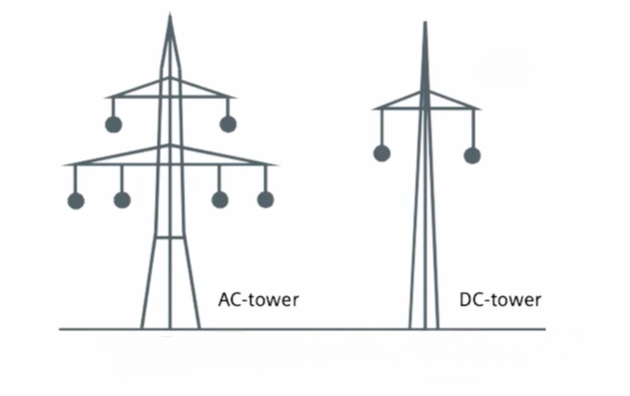
As a result, HVDC towers are lighter, smaller, and easier to install. This leads to long-term benefits despite higher initial costs.
Cost Considerations in HVDC Transmission
HVDC systems require high initial investment. Converter stations are expensive and complex. Because of this, HVDC is not suitable for every project.
Engineers evaluate several factors before choosing HVDC. These include distance, power capacity, system requirements, and economic feasibility.
Break-Even Distance Concept
The break-even distance defines when HVDC becomes economical compared to HVAC. Beyond this distance, lower losses and higher efficiency offset the initial cost.
Below this distance, HVAC transmission remains more cost-effective. This concept helps planners choose the right technology for each project.
When HVAC Is Still the Better Choice
HVAC transmission is suitable for shorter distances, typically below 200 kilometers. It also works well when both systems operate at the same frequency.
HVDC is chosen only when specific conditions demand it. It complements AC transmission rather than replacing it.
Real-World HVDC Transmission Projects
Rihand–Dadri HVDC Project in India

The Rihand–Dadri project in India spans 814 kilometers. It operates at 500 kV DC and transmits 1,500 megawatts of power. This project demonstrates the effectiveness of HVDC in long-distance transmission.
Western HVDC Link in the United Kingdom
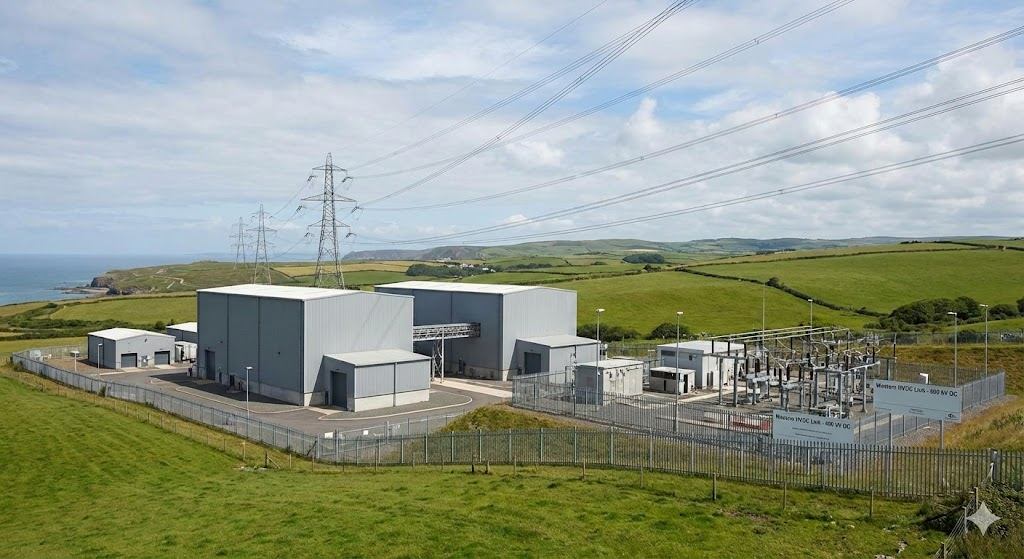
The Western HVDC Link in the UK is 422 kilometers long. It operates at 600 kV DC and transmits 2,200 megawatts of power. This link improves grid stability and power transfer capability.
North Sea Link Between Norway and the UK
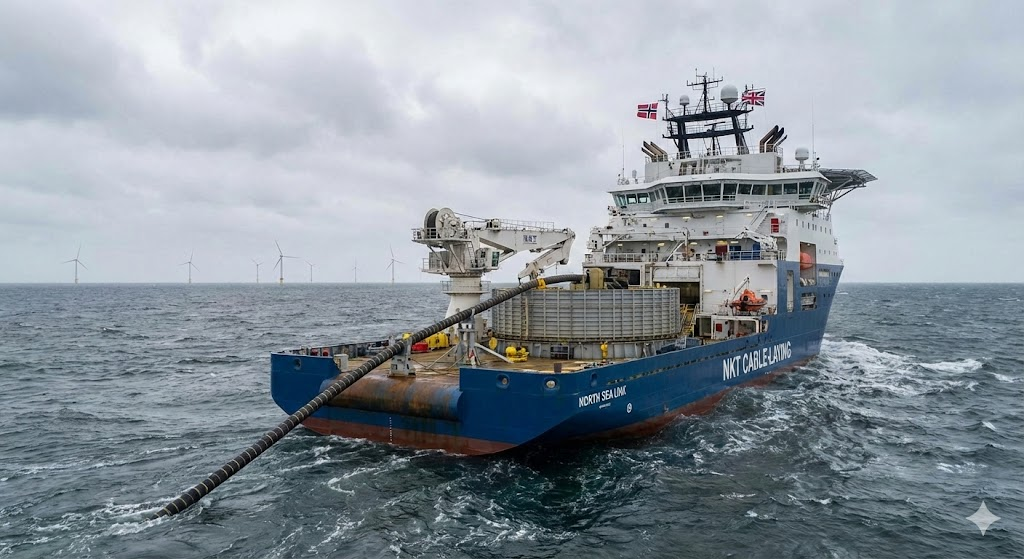
The North Sea Link connects Norway and the UK over a distance of 730 kilometers. It operates at 515 kV DC and transmits 1,400 megawatts of power. The entire link uses offshore cables, making it one of the longest submarine HVDC projects.
Importance of Offshore HVDC Transmission
Undersea AC cables face severe capacitive issues. These issues limit transmission distance. HVDC eliminates this problem, making it ideal for offshore power transmission.
This is why most long submarine links rely on HVDC technology.
Choosing Between HVAC and HVDC Transmission
Every transmission project has unique requirements. Engineers analyze distance, power level, frequency compatibility, and system strength before making a decision.
HVDC is selected only after careful evaluation. It is used where its advantages clearly outweigh its cost.
Conclusion
This article explained the Introduction to HVDC Transmission in a structured and simple manner. It followed the same flow as the video transcript and covered all the points discussed. No additional technical concepts were added.
For visual explanations and better clarity, it is recommended to watch the full video linked above. It provides diagrams and examples that further strengthen understanding.

